
In terms of chemistry, redox is far from simple to explain (ORP). In this micro-guide, we will try to popularize it to make you understand the importance of measuring this parameter in a natural pond to improve the quality of the water.
In a pond, the objective is always to maintain good aerobic conditions. For this, the Redox must be positive. A redox level below 150 means that there is no oxygen available for the biology of your body of water.
What is the optimal Redox rate in a pond?
In aquaculture, the objective should be to maintain aerobic – redox conditions above 100 mv minimum. It is not uncommon to analyze a eutrophied pond and end up with very negative values. Before adding bacteria, it will be necessary to raise this redox level in the pond. With a redox level below -100, the bacteria risk disappearing directly.
During our projects, we often speak with owners of water bodies or fish farms who ask us about the importance of redox (oxidation-reduction potential. It is also found under the name ORP.
In ponds, dissolved oxygen in the water is also often analyzed to ensure that the pond maintains a satisfactory concentration of available oxygen.
Oxidation-reduction reactions
In water chemistry, chemical reactions are governed by different mechanisms, but often the most important are redox reactions. In an oxidation reaction, a substance loses electrons and becomes more electropositive in valence, while the opposite occurs when a substance is reduced.
Redox potential is measured as a flow of electrons from a standard concentration of a substance to or from a hydrogen electrode that is assigned an electrical potential of zero.
The flow of electrons measured during a redox reaction is the redox potential; but, depending on the substance compared to the hydrogen electrode, the flow of electrons can be in both directions.
The usual procedure is to assign a positive value to the redox potential as electrons flow from the hydrogen electrode to the other substance. A positive value is assigned when electrons flow from the other substance to the hydrogen electrode. The larger the redox numerical value, the more the other substance is oxidized or reduced compared to the hydrogen electrode.
A high positive redox potential indicates that a substance is strongly oxidized relative to the hydrogen electrode. A high negative redox potential means that a substance is greatly reduced compared to the hydrogen electrode.
Tables of standard hydrogen electrode redox potentials for many substances are available in most general chemistry books. Of course, during the reaction between a substance and the hydrogen electrode, the redox potential progresses towards zero. A redox potential of zero occurs when the two substances are in equilibrium with each other with respect to electron flow.
The theoretical redox potential for fresh water of pH 7 containing 8 mg/L DO and at 25 degrees-C, the redox potential is 0.802 volts. However, in practice, a mercurous chloride (calomel) electrode is used for practical redox measurements.
pH has an effect on redox. To adjust an ORP measurement to pH 7, 0.0592 volts per pH unit is subtracted from the ORP measured at a lower pH or added for the ORP measured at a higher pH. An increase in temperature of 1 degree C results in an increase in ORP of 0.0016 volts, but ORP instruments usually have a "built-in" temperature compensator.
In a thermally stratified lake, ORP can drop very low - even to negative values - when the DO concentration falls to 0 mg/L in deeper (hypolimnetic) water. However, in aquaculture ponds that do not normally thermally stratify, the redox potential will generally be greater than 0.50 volts at the sediment-water interface due to the presence of DO. Redox drops rapidly to 0.2 volts or less at a depth of a few millimeters in sediments due to oxygen depletion resulting from microbial activity. The redox potential also drops rapidly in sediments, even in nutrient-poor (oligotrophic) lakes. However, the sediment depth for a redox of 0.2 volts may be 5 to 10 cm below the soil-water interface.
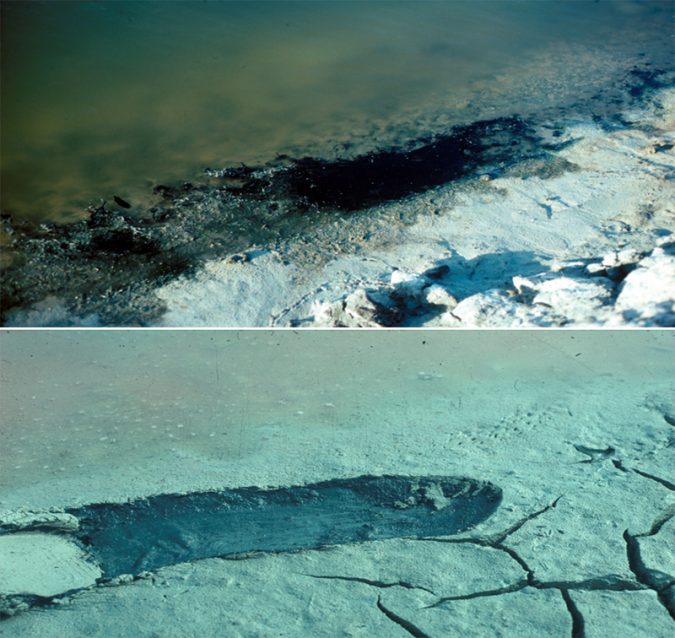
In aquaculture ponds, the goal should be to maintain aerobic - redox conditions above 0.5 volts or greater at the sediment-water interface. A redox reading is not necessary to check this condition, because when the redox drops to approximately 0.2 to 0.3 volts, the color of the sediment (soil) surface becomes darker - often dark gray or black. The desirable condition on the ground surface is shown (Fig. 3). The thin surface layer is aerobic and lighter in color than the anaerobic layer a few millimeters below, as revealed by scanning the thin surface layer. The color change is the result of the reduction of ferric iron (Fe 3+ ) to ferrous iron (Fe 2+ ) at a redox close to 0.2 volts. The ORP must drop to 0.0-0.1 volts before the bacteria begin converting sulfate to sulfide. However, as long as oxidizing conditions exist at the sediment-water interface, there will be little movement of sulfide into the water above.
Redox measurement problems
The main problems associated with redox measurement are that the probe containing the redox electrode is rather large (about the diameter of a pencil), and when inserted into the sediment, oxygenated water from above the sediment penetrates around of the probe, affecting the redox potential. It is also virtually impossible to know the exact depth at which the probe detects ORP, and ORP can change dramatically over 1 or 2 mm of depth. There are also calibration issues with redox probes, and many do not read 0.56 volts in hydrogen peroxide. However, one can determine whether the redox potential increases or decreases with such probes.
A low DO concentration can be detected easily with a polarographic DO meter, and a low DO concentration alerts one to a low redox potential. The darkening of the sediment surface also indicates that the redox is low enough for the presence of ferrous iron and too high for the presence of nitrate (the most oxidized form of nitrogen). The rotten egg smell of sulfide is detectable at a very low concentration of this substance - it is not necessary to measure redox to know if hydrogen sulfide is being produced.
Perspectives
Redox potential is not an easy or reliable technique for assessing water quality for aquaculture animals. The practical aquaculturist should focus on maintaining an adequate DO concentration in the water by balancing stocking and feeding rates with the amount of mechanical aeration applied. Positioning aerators to ensure circulation of oxygenated water across the pond bottom is helpful in preventing anaerobic conditions at the sediment-water interface. Some aquaculturists apply sodium nitrate to ponds as a sediment oxidizer. The presence of nitrate in the water to promote denitrification maintains the redox potential at an acceptable level to prevent highly reduced substances such as hydrogen sulfide from entering the water column.