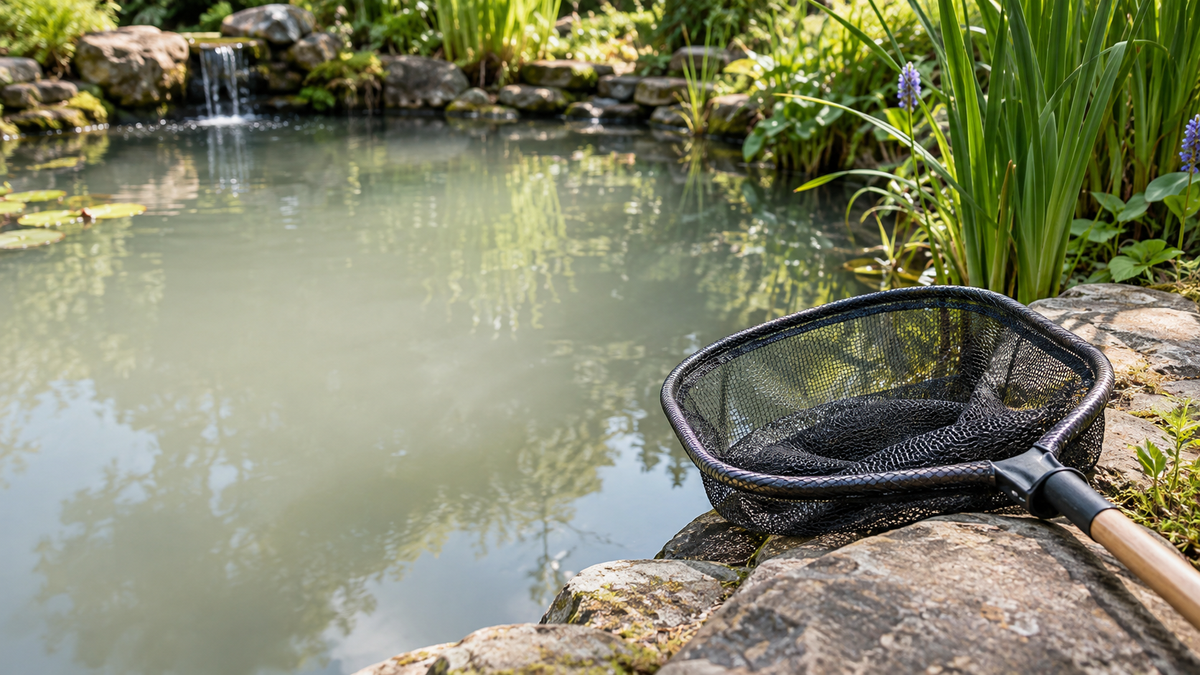
Cloudy water after cleaning a pond may be caused by resuspended particles or biological changes related to the intervention. Color alone is not enough to decide. To choose the right response, identify what was cleaned, check the circulation, and measure the parameters important to the fish.
The reflex to immediately wash everything again can prolong the problem, especially if the biological media have already undergone a major intervention. Conversely, waiting without checking the water is not appropriate when the fish show distress. Here is how to distinguish these situations and use Aquipond solutions in a program that addresses the identified cause.
Return to the last water observed before the intervention
Note the appearance of the pond before cleaning and the time when the cloudiness appeared. Water that turns cloudy as soon as a basket is moved points to a different search than a cloudiness that develops after a media replacement and a resumption of feeding. The timeline provides a useful first sorting.
List the operations carried out: bottom vacuuming, stone brushing, foam rinsing, media replacement, water addition, planting, or the use of a product. Indicate the quantities and references when you know them. Several small changes made on the same day can have a common effect on the system.
If someone else carried out the maintenance, ask for a concrete description of the equipment and methods used. "The filter was cleaned" can cover a simple mechanical rinse or the complete replacement of its media. This difference counts a lot for interpreting the analyses that will follow.
Observe the fish before looking for clarity
Check the activity and respiration of the fish. Collective distress, fish at the surface, or unusual behavior require a quick check of the water quality and equipment. Make sure the circulation and aeration are working, suspend feeding, and ask for competent help if necessary.
The cloudiness can draw all attention while another problem is occurring simultaneously. A poorly reassembled filter, a primed pump, or an error during filling must be looked for. The safety of the fish does not depend solely on the number of visible particles in the water.
Prepare the results of temperature, pH, ammonia, and nitrites, as well as the other available analyses. Note the units and methods. A photograph of the cloudiness is useful to describe the appearance, but it does not allow you to determine the concentration of invisible compounds.
Look for a resuspension of fine materials
Brushing, vacuuming, or moving plants can release previously deposited particles. Some are organic, others come from a mineral substrate. The pond must then be able to recover them or let them settle in an area where they can be removed in an appropriate way.
Take water in a clean transparent container. Examine it against a clear background, then observe what happens at rest. The formation of a deposit constitutes an indication of settleable materials. However, the absence of a quick deposit does not prove that the cloudiness is exclusively biological.
Inspect the planting baskets and recently added materials. An uncontrolled substrate or a basket stirred by the fish can continue to release fines after cleaning. It is then necessary to correct this source rather than asking the filter to compensate indefinitely for new inputs.
Assess a biological disruption without concluding too quickly
A major cleaning can change the media and the communities that participate in the water's operation. A proliferation of suspended microorganisms is one of the possible hypotheses in the face of a whitish cloudiness, but it is not confirmed by the eye alone. The history and analyses must guide the interpretation.
Check particularly what was done to the biological media. Were they replaced, left outside their normal conditions, or cleaned with an unsuitable method? Was the entire pond refurbished at the same time? This information helps assess the remaining treatment capacity.
A rise in ammonia or nitrites requires appropriate management, regardless of the color of the water. Do not try to hide the cloudiness to consider the maintenance finished. The return to satisfactory operation must be confirmed by the relevant parameters and the stability of the system under its actual load.
Check the reassembly and water flow
After cleaning, an element may be replaced in the wrong direction, a valve may remain partially closed, or a media may leave a bypass passage. Check the manufacturer's procedure and compare it with a photo of the usual configuration if you have one.
Observe the useful flow, the levels, and any overflows. A flowing waterfall does not guarantee that all filtration steps are working. Also check the screens and baskets, which can receive a large load of detached materials during the first phases of restart.
Avoid adding a very fine mass at random to retain more particles. It could quickly clog or change the levels. Any mechanical adaptation must remain compatible with the equipment and be monitored. The goal is to recover the materials without disrupting the circulation necessary for the pond.
Choose between clarification and biological support
| Identified need | Solution to examine | Prerequisite condition |
|---|---|---|
| Suspended particles to group and recover | Aquipond Clearwater | Compatible diagnosis and planned mechanical extraction |
| Restart of a disrupted biological filtration | Aquipond NitriBoost | Functional circuit and monitoring of nitrogen parameters |
| Permanent entry of substrate | Correction of the basket or the layout | Identify and stop the source |
| Concerning results with affected fish | Urgent appropriate assessment | Protect the fish and analyze the environment |
This table does not impose using both products. It helps avoid a single response to all cloudy water. If several causes coexist, prepare an order of intervention compatible with the instructions and the situation, rather than a mixture of products applied at the same time.
Clearwater when particle recovery is the right goal
Aquipond Clearwater can be considered to facilitate the grouping of particles and their capture. The preparation includes the actual volume, the water checks, and the organization of the filtration. The product is only useful if the materials concerned can then be removed from the system.
Consult the current packaging instructions and have the filtration settings, aeration, and the interval between applications confirmed. These instructions are not inferred from another brand or an old advice. Also respect the compatibility conditions with the other interventions carried out after cleaning.
Monitor the load recovered in the filter and the evolution of visibility from the same point. If a source continues to release fines, it must be corrected. Repeating an application without this correction can make the program unnecessarily long and difficult to interpret.
NitriBoost when the biofilter requires a supervised restart
Aquipond NitriBoost can be integrated when the diagnosis concerns the biological function of the filtration. Check the media, circulation, and water conditions before application. A starter product cannot make a poorly reassembled circuit work correctly.
The temperature, pH, volume, and other conditions in its instructions must be respected. Continue to monitor ammonia and nitrites with an appropriate method. The desired result concerns the biological transformation under a controlled load, and is not judged solely by the disappearance of the cloudiness.
Avoid any new introduction of fish until the capacity of the system has been assessed. Organize the resumption of feeding according to the observations and adapted advice. The biological correction and the load management must move together to regain an understandable operation.
Prepare a less disruptive cleaning next time
Identify the truly necessary operations and distinguish their objectives. Removing waste from the bottom, cleaning a mechanical step, and intervening on the biological media are not interchangeable actions. When the situation allows, plan the interventions to avoid changing all the important elements without the possibility of monitoring.
Keep a photo of the assembly, the usual levels, and a few reference measurements. Prepare the recovery equipment before starting to detach materials. Maintenance is carried out more simply when you know where the waste will be captured and how it will be removed.
Also keep a little time after the restart. Monitoring the flow, the baskets, and the fish is part of the cleaning. Finishing the operation at the exact moment the pump restarts can let a problem pass that is easy to correct during the first observations.
Before the next cleaning, prepare:
- A photo of the filter assembly and the position of the valves.
- The usual water levels and a few reference measurements (pH, KH, nitrites).
- The equipment to recover and remove the detached waste.
- A bucket of pond water to rinse the filter elements.
- Time to monitor baskets, flow, and fish after the restart.
Do not forget the water used during cleaning
If you have renewed part of the volume, indicate the origin of the added water and its preparation. Tap water, stored rainwater, or well water is not judged solely by its clarity. Check its compatibility with the fish and the system, as well as the differences in temperature and parameters. This step avoids attributing to cleaning alone a change caused in part by the filling.
Frequently asked questions about cloudy water after maintenance
Should you wait a fixed number of days?
There is no universal waiting time. The duration depends on the cause, the quantity of materials, and the operation of the pond. If the fish are affected or the analyses are concerning, waiting based solely on appearance is not appropriate.
Is a second major cleaning the best response?
Not without a diagnosis. It can remove an identified source, but it can also further disturb the media or re-suspend new materials. Start by restoring the previous intervention and checking what actually requires correction.
Can fish be added as soon as the bottom is visible?
Visibility alone does not confirm biological capacity. Analyses, the existing population, and the system's performance under the current load must guide this decision. Water that has become clear again may still require monitoring before any further introduction.
After cleaning, therefore, aim to restore a stable and controlled system. Clarity then becomes a useful indicator among others, along with the Aquipond solutions chosen for the function actually required.
Read also
- Clean filter, cloudy water: what to check in your pond?
- Filling a pond with rainwater: useful precautions
- Filter stopped: how to prepare for restarting?
In doubt about your body of water? A film that won't go away, test results to interpret, or worried fish: describe the maintenance carried out, and we will help you find the cause.
Get a free diagnosisSend a photo to an expertSources and technical references
- Merck Veterinary Manual — fish environment and filtration control.
- Oklahoma State University Extension — common pond problems.
- Aquipond Clearwater and NitriBoost fact sheets, consulted on October 10, 2026; refer to the current instructions and those of the filter for implementation.