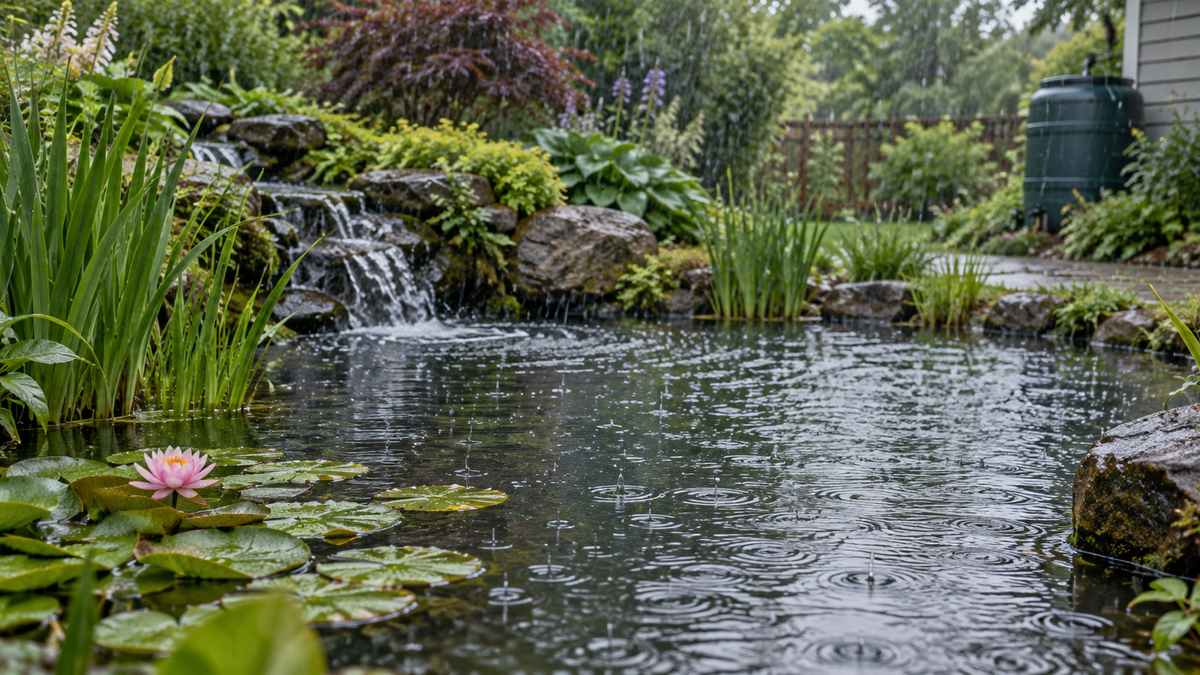
Rainwater can help fill a pond, but it must be assessed before use. Its quality depends on the collection route, storage, and the resulting mix in the pond. Clear water is not necessarily suitable for fish, and low-mineral water requires particular attention to KH and GH.
A good project does not start by connecting a gutter directly to the pond. It begins with three questions: where does this water come from, what does it contain after its journey, and how will it affect the pond? Here is a method for controlled use, with Aquipond correctors only when tests show they are necessary.
Direct rain and collected water: two routes to examine
Rain falling directly on the surface of the pond reaches it without passing through a roof or tank. Collected water, on the other hand, travels over several surfaces before reaching its place of use. It can carry dust, debris, droppings, or substances from nearby materials and activities.
The natural character of rain is therefore not a guarantee of quality. A recently treated roof, a surface containing unsuitable materials, or a tank that has held another product requires particular assessment. A filter that catches leaves does not prove the absence of dissolved contaminants.
Draw the complete route on a sheet of paper: collection surface, gutter, any diversion device, storage, overflow, and arrival at the pond. This diagram often reveals a forgotten point, such as a soil entry into the tank or a discharge that can return to the pond after heavy rain.
Check storage before filling
Inspect the tank under safe access conditions, without entering a confined space. Check its previous use, its closure, accessible deposits, and the maintenance recommended by its manufacturer. Water stored for a long time in poor conditions should not be used simply because it represents an available volume.
Take a sample at the point that will actually be used for filling. Water drawn from the surface of the tank may differ from that drawn near a deposit. Observe the smell and appearance, then perform the appropriate tests. An abnormal smell or discoloration should trigger an investigation into the cause, not an attempt to mask it with a product.
Depending on the origin and identified risks, standard pond tests may be insufficient. pH, KH, and GH do not provide information on all contaminants. If the route involves suspicious exposure, ask what specific tests are necessary before use. Mineral correctors are not designed to make contaminated water suitable.
Understand what KH and GH measure
KH is used in pond maintenance as an indicator of alkalinity, that is, the water's ability to neutralize certain acidic inputs. Low KH can make the pH less stable. GH corresponds to total hardness, mainly related to calcium and magnesium ions. These two results describe different properties.
Low-mineral rainwater can dilute the mineral characteristics of pond water when added in large quantities. However, the effect depends on both waters and their proportions. Measure the actual mix; do not deduce a dose of corrector from the weather forecast alone.
pH provides yet another piece of information. Its change cannot be calculated as a simple arithmetic average of two values, because it depends on chemical balances and buffering capacity. A reliable method consists of measuring the waters, preparing a suitable use, and then checking the effect under comparable conditions.
Example to understand the importance of the added volume
Imagine a pond containing 8,000 liters before an addition of 2,000 liters. Without any other input or output, the final volume would be 10,000 liters, and the added water would represent 20% of this total. This example is used to visualize a proportion; it does not predict the pH or all parameters of the mix on its own.
If a KH measurement indicated 6 degrees in the initial water and a value close to zero in the added water, a simplified dilution calculation would give approximately 4.8 degrees for the mix. This estimate assumes the absence of other significant reactions and exchanges. It must be confirmed by a test and does not constitute a universal correction guideline.
In reality, an overflow, simultaneous renewal, or an inaccurately known initial volume changes the reasoning. Therefore, note the starting level, the added volume, and the observed outputs. A meter reading provides more solid information than an estimate based on how long the hose was left open.
When to use Aquipond KH+
Aquipond KH+ is intended to increase KH when analysis shows a need. Its role is understood within a water stability approach. It is neither a clarifier nor a product capable of correcting all the consequences of poorly controlled collection.
Before using it, check the volume actually affected and the packaging instructions. Set the goal based on the pond's needs and proceed according to the indicated protocol, monitoring the change. A scoop is not a universal mass unit: its capacity and the product-specific instructions must be known.
If KH drops again regularly, look for the cause instead of considering repeated additions as inevitable. Renewals with low-mineral water, precipitation, and biological operation can contribute to the balance. Monitoring volumes and tests helps build more predictable maintenance.
When does GH require a separate correction?
An unsuitable GH value for the pond's needs may lead to examining Aquipond GH+. The choice stems from the GH measurement, not the KH measurement. It may be necessary to consider both parameters, but you should not buy both correctors automatically.
Check the quality of the test, its unit, and the reading conditions. The degrees used on some tests should not be confused with concentrations expressed in another unit. Keep the result as given and ask for a reliable conversion if you are comparing several documents.
A GH corrector does not replace a pH check, and a KH corrector does not necessarily provide the desired total hardness adjustment. Presenting the results separately allows you to choose the right tool and avoid unnecessary correction. After the intervention, the new measurement verifies what has actually changed.
Prepare the filling without causing a sudden change
Compare the temperature and characteristics of the available water with those of the pond. The larger the share of the added volume, the more attention its preparation deserves. Fish should not undergo a major variation simply because a tank needs to be emptied or an aesthetic level is desired.
Define the filling method with the constraints of your installation and the recommendations suited to its inhabitants. Monitor the level, overflows, and equipment operation. A hose left uncontrolled can change the volume or the mix of waters much more than expected, especially in a small pond.
Perform measurements after a representative mix, according to a consistent method. A sample taken right in front of the inlet may mainly describe the added water. Note the location and time of the test to interpret the result. Also observe the fish and circulation; the quality of monitoring does not rely on a single value.
Filling in practice:
- Measure the pond and the tank water (pH, KH, GH, temperature) before starting.
- Estimate the share the added water will represent in the final volume.
- Add the water gradually, monitoring the level, overflow, and fish.
- Let the water mix, then take a sample far from the inlet point.
- Note the added volume, the location, and the time of the test, then correct only if the measurement justifies it.
Organize a truly useful water reserve
Storage capacity must be planned with the needs and periods of availability. A large tank does not guarantee that the water will be usable at the desired time. Plan for maintenance, secure access, the possibility of setting aside questionable water, and another appropriate supply when the reserve is not suitable.
In regions subject to dry periods, notably certain areas of Portugal or Spain, also check the local rules applicable to water use. They may change. A general article does not replace the instructions of the municipality or the competent authority during a restriction.
Keep a sheet with the collection route, maintenance dates, tests, and volumes used. It will be useful if someone else takes care of the garden. It also allows you to identify a change more quickly: work on the roof, a tank change, or a new product used nearby.
What your monitoring sheet should contain:
- The collection route (roof, gutter, tank, inlet).
- The maintenance dates of the tank and filters.
- Each test with its unit, location, and time.
- The added volumes and their origin (rain, network, well).
- Changes around the collection: work, new product, new tank.
Topping up evaporation and replacing water are two different situations
When water evaporates, a large part of the dissolved substances remains in the pond. When water leaves through an overflow or renewal, it also takes away part of these substances. An addition intended to restore the initial level is therefore not reasoned exactly like a replacement after partial emptying. Note the cause of the level drop and confirm the result with tests rather than automatically correcting after each filling.
Frequently asked questions about rainwater and the pond
Can clear rainwater be used directly?
Clarity is not enough. You need to know the route and check the relevant parameters, as well as the risks of contamination. The absence of visible particles does not provide information on all dissolved substances nor on the compatibility of the mix with the pond population.
Should you remineralize after every shower?
No. The decision depends on the measurements and the proportion of water received. Automatic application can lead to correcting a parameter that does not need it. Follow the trends of KH and GH and intervene according to the confirmed needs and the instructions of the chosen product.
Can you compensate for questionable water with KH+ and GH+?
These products meet precise mineral objectives. They do not constitute a universal treatment of contaminants. If the origin of the water is a problem, resolve this question first and use a suitable supply. Mineral adjustment only comes in water whose use has been judged suitable.
The right decision: know the source, measure both waters, and control the added volume. The Aquipond KH+ and GH+ solutions then allow you to meet an identified need, with controls that make the result understandable and reproducible.
Read also
- GH and KH of the pond: what difference, what corrector?
- pH too low in a pond: diagnosis and correction
- Nitrites in a new pond: understand and act
Sources and technical references
- Mississippi State University Extension — Pond pH and Alkalinity.
- FAO — Water Quality and Pond Management.
- Aquipond KH+ and GH+ fact sheets, consulted on October 10, 2026. The numerical mixing examples are for educational purposes and do not replace testing.
Concerned about your body of water? Water in a tank with an unusual odor, KH that drops after every refill, or restless fish: describe your situation to us, and we'll help you choose the right course of action.
Get a free assessmentSend a photo to an expert