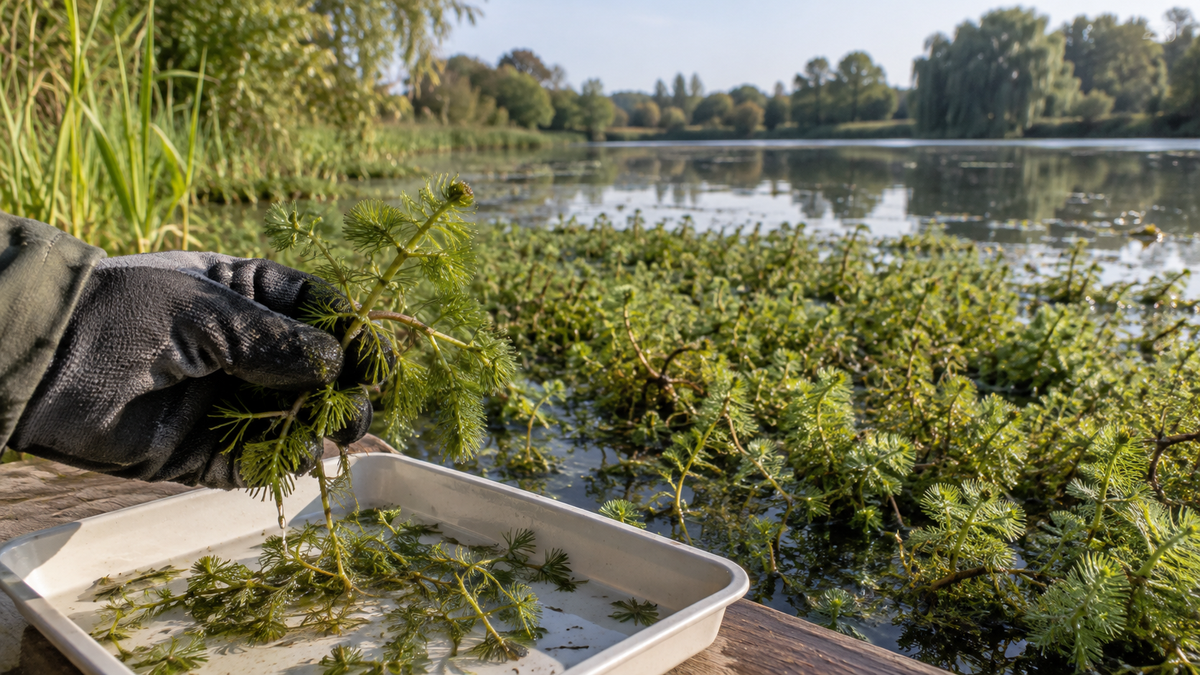
In short: the most common invasive pond plants in Europe are Brazilian waterweed, Canadian and Nuttall's pondweeds, dense waterweed, giant waterweed, water primrose, Helms' crassula and ranunculus-leaved hydrocotyle. They proliferate in shallow, lit, nutrient-rich waters and can regrow from the smallest fragment. The most effective method combines pulling or cutting with complete removal of debris, shading the water against submerged species, and reducing nutrients in the silt.
What is an invasive pond plant?
An invasive exotic plant is a species introduced outside its native range, often through the aquarium or aquatic garden trade, which naturalizes and then multiplies to the point of dominating the environment. In a pond, it forms dense beds that hinder fishing, swimming, and flow, and deprive native plants of light.
Two situations must be distinguished. Some native plants, such as spike waterweed, water milfoil, or certain pondweeds, can also become invasive in a water body that is very rich in nutrients: we then speak of invasive beds, but the species is not exotic. The species described below are exotic and harder to contain, due to the lack of consumers and specific diseases in Europe.
How to recognize the main invasive species in water bodies?
Brazilian waterweed (Myriophyllum aquaticum)
Native to South America. Finely divided feathery leaves, blue-green, arranged in whorls (crowns) of 4 to 6 around the stem. Its distinctive sign: stems that stand out of the water, like little fir trees, on the banks and in shallow areas. In Europe, only female plants are present: it spreads only by fragments.
Canadian pondweed and Nuttall's pondweed (Elodea canadensis, Elodea nuttallii)
Native to North America, entirely submerged. Small leaves of about 1 cm, grouped by 3 around the stem. Those of Canadian pondweed are rather wide and rounded at the tip; those of Nuttall's pondweed are narrower, pointed, and often curved or twisted. Nuttall's pondweed, which arrived more recently, is now the most aggressive of the two.
Dense waterweed (Egeria densa)
Native to South America, sold for aquariums for a long time. It resembles a large pondweed: leaves of 2 to 3 cm, grouped by 4 or 5. In summer, it can bear white flowers with three petals that emerge just above the water.
Giant waterweed (Lagarosiphon major)
Native to southern Africa, also called curly pondweed. Its leaves are not in crowns but arranged in a spiral along the stem and clearly curved backwards. Its brittle stems form very dense beds.
Water primrose (Ludwigia grandiflora, Ludwigia peploides)
Native to the American continent. Amphibious plants: creeping then upright stems, alternate leaves, large yellow flowers with five petals in summer. Unlike the previous species, they can also produce seeds.
Helms' crassula (Crassula helmsii)
Native to Australia and New Zealand. Small plant with opposite fleshy leaves, from a few millimeters to about 2 cm, with tiny white flowers with four petals. It grows as well submerged as on the exposed banks and forms tight mats. A fragment of a few millimeters is enough to make it regrow, making it one of the hardest species to eliminate.
Ranunculus-leaved hydrocotyle (Hydrocotyle ranunculoides)
Native to North America. Round leaves with lobed edges, several centimeters long, carried by floating stems that root at the nodes. It forms floating mats that start from the banks and can cover the entire surface of a small water body.
Why do these plants explode in a pond?
Their proliferation is due to four cumulative factors:
- Light. A submerged plant only grows where light reaches the bottom. Very clear and shallow water is therefore an ideal environment.
- Nutrients. Rooted plants draw nitrogen and phosphorus directly from the silt. A silty pond, fed by dead leaves and runoff, offers an almost unlimited supply.
- Shallow depth. In a pond of less than about 2 meters, almost the entire bottom is lit and therefore colonizable.
- Fragmentation. A piece of stem broken by a propeller, a bird, a net, or a flood takes root elsewhere. Cutting without collecting is equivalent to sowing.
How to get rid of invasive plants in a pond?
No single method is enough. Lasting results come from a combination: remove the biomass, limit light for submerged species, and cut off their food supply by reducing nutrients. Our solutions are grouped in the invasive plants collection.
Steps for a pulling or cutting intervention
Cutting consists of cutting aquatic beds, by hand or with a barge equipped with a cutting bar, then removing them from the water. Pulling removes the plant with its roots, which is preferable when possible.
- Identify the species before acting: the method changes depending on whether it is submerged, floating, or amphibious.
- Choose the period: generally before the beds reach the surface and, for water primrose, before flowering. Take into account the nesting of waterfowl in spring.
- Isolate the area: place a net or a floating barrier downstream, especially near an overflow or outlet.
- Cut or pull slowly, from upstream to downstream, to limit the dispersion of fragments.
- Collect all fragments with a net or rake, including those that float up the following days.
- Manage the waste: drying on a tarp away from the water, then composting away from ditches or at a waste disposal site. Never store on a floodable bank.
- Clean the equipment (waders, nets, boat, trailer) on site before leaving the site.
- Return several times in the season, then the following year: regrowth from forgotten fragments is the rule.
Equipment to prepare before starting:
- A net or floating barrier for downstream.
- A fine-mesh net and a rake.
- A drying tarp, installed away from the water.
- What is needed to clean waders, nets, and boat on site.
- A map of the pond to mark the treated areas and return to them.
On a large water body, the operation requires suitable equipment. Aquipond offers a day-rate cutting service, with collection of cut plants.
Shading the water against submerged species
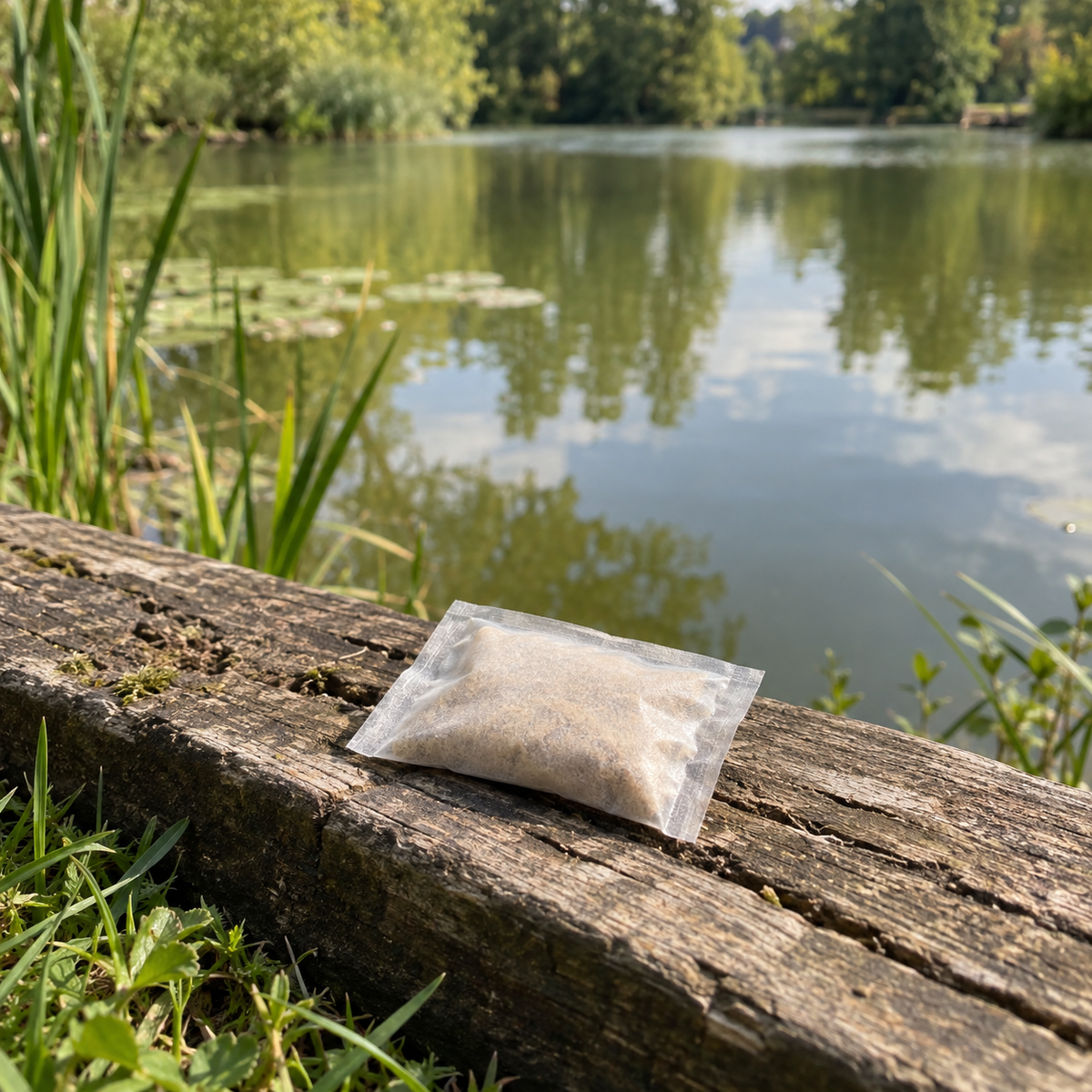
Canadian and Nuttall's pondweeds, dense waterweed, and giant waterweed depend on the light that passes through the water column. A blue biological dye like Blue Lake filters part of the spectrum useful for photosynthesis and slows their growth. Against plants, the dose is 2 sachets of 100 g per 1,000 m², renewed every 4 to 6 weeks. The treatment gives the best results if it starts in spring, before the beds rise, in a water body without strong renewal. It remains little effective on emergent or floating parts (water primrose, hydrocotyle, upright stems of Brazilian waterweed). For more details, see our presentation of Blue Lake.
Reducing nutrients in the water and silt
As long as the silt remains rich, the beds regrow. Two complementary levers:
- Fix the phosphorus: the SeDox Max by OASE captures phosphorus in the water and in the silt, at a rate of about 5 kg per 100 m³ of water.
- Reduce organic silt: the bacteria of Bactovase degrade the organic matter accumulated at the bottom. Count 100 g/m² for maintenance and 150 to 200 g/m² for a heavily silty pond, in two applications per year, in spring and autumn. Our guide for reducing silting details the process.
There are also approaches without products: limit the inputs of leaves, remove fish feeding, create a grass strip against runoff, aerate the water. Once the invasives are contained, replanting native plants on the banks and in shallow areas helps to occupy the space; see our selection of oxygenating plants, making sure to choose local species.
Which method for which species?
| Species | Recognition | Priority method |
|---|---|---|
| Brazilian waterweed | Feathery blue-green leaves, stems standing out of the water | Pulling with roots, meticulous collection of fragments, repeated passes |
| Canadian pondweed | Leaves by 3, wide, rounded tip, submerged | Cutting with collection, shading, nutrient reduction |
| Nuttall's pondweed | Leaves by 3, narrow, pointed, often twisted | Cutting with collection, shading, nutrient reduction |
| Dense waterweed | Leaves by 4 or 5, from 2 to 3 cm, white flowers with 3 petals | Cutting with collection, shading |
| Giant waterweed | Leaves in a spiral curved backwards, brittle stems | Pulling or cutting with downstream net, shading |
| Water primrose | Amphibious plant, yellow flowers with 5 petals, alternate leaves | Manual pulling with roots before flowering, several years of monitoring |
| Helms' crassula | Small opposite fleshy leaves, tight mats on banks and bottom | Containment and specialized intervention; avoid any cut that fragments |
| Ranunculus-leaved hydrocotyle | Round lobed leaves, floating mats from the banks | Manual removal of mats with a net or rake, complete collection |
How to prevent the arrival of invasive plants?
- Never release the contents of an aquarium or an ornamental pond into a pond, ditch, or river. Several of these species were introduced exactly this way.
- Clean and dry the equipment (waders, nets, boats, nets, fishing gear) between two water bodies.
- Monitor the banks every spring: a small patch detected early is eliminated in an hour, an established bed takes years.
Regarding regulations, several of these plants are on the list of invasive alien species of concern for the European Union, which prohibits their trade and planting (see FAQ). For a major intervention on a watercourse or protected wetland, inquire beforehand with the water police or the DDT in France, or the competent regional administration in Belgium.
Mistakes to avoid
- Cutting without collecting. Every fragment left in the water can become a new plant.
- Intervening too late. A bed that has reached the surface produces far more fragments.
- Throwing the waste on the bank. At the first rise of the water, it returns to the pond.
- Counting on a single pass. Invasives are managed over several seasons.
- Forgetting the silt. Without nutrient reduction, the pond recolonizes the freed space, by the same plant or by algae.
- Using a herbicide. The use of herbicides in the water or nearby is very regulated, or even prohibited, depending on the country. In addition, the sudden decomposition of the plants causes dissolved oxygen to drop, that is, the amount of oxygen available in the water for the fish.
Frequently asked questions
What invasive plants are most often found in ponds in Europe?
The most frequent are Brazilian waterweed, Canadian and Nuttall's pondweeds, dense waterweed, giant waterweed, water primrose, Helms' crassula, and ranunculus-leaved hydrocotyle. All are exotic and spread mainly by stem fragments.
Can you pull out Brazilian waterweed yourself?
Yes, on a small area, provided you work slowly, collect every fragment with a net, and place a net downstream if there is a flow. On a large pond, mechanical cutting with complete collection is more effective. Plan several passes per season: the plant regrows from every forgotten cutting.
Does the blue dye work against all invasive plants?
No. A dye like Blue Lake reduces the light that reaches the bottom: it slows submerged plants like pondweeds, dense waterweed, or giant waterweed. It has little effect on the emergent or floating parts of water primrose, hydrocotyle, or Brazilian waterweed, which capture light above the water.
What to do with pulled invasive plants?
Never throw them back into the water or store them on flood-prone banks. Let them dry on a tarp away from the body of water, then compost them away from any ditch or take them to a waste disposal site as green waste. The goal is to prevent any living fragments from reaching an aquatic environment.
Is it illegal to sell or plant these species?
Several of them, including Brazilian waterweed, Nuttall's waterweed, both water primroses, water scepter, and false-rucola waterweed, are on the European Union's list of invasive alien species of concern. Their trade, planting and release into the wild are prohibited there. For other species, check with your regional authority or water police.
Read also
- Duckweed in a pond: how to get rid of it
- Phosphorus in the pond: sources, measurement and solutions
- Natural pond maintenance: the month-by-month calendar
Unsure about your body of water? You don't know which plant has invaded your pond or which method is right for it? Use our free diagnostic tool or send us a photo.