Recurring filamentous algae indicate that one or more conditions remain favorable to them. Removing them or using a suitable solution can reduce their visible presence. To prevent recurrences, you must also consider nutrient inputs, deposits, light, circulation, and the pond's biological function.
The starting point is therefore not to look for an increasingly powerful product. It consists of understanding where the filaments develop, how quickly they return, and what has changed in the installation. This guide offers a practical method for building a coherent maintenance program with Aquipond solutions, without multiplying blind applications.
First confirm that you are observing filaments
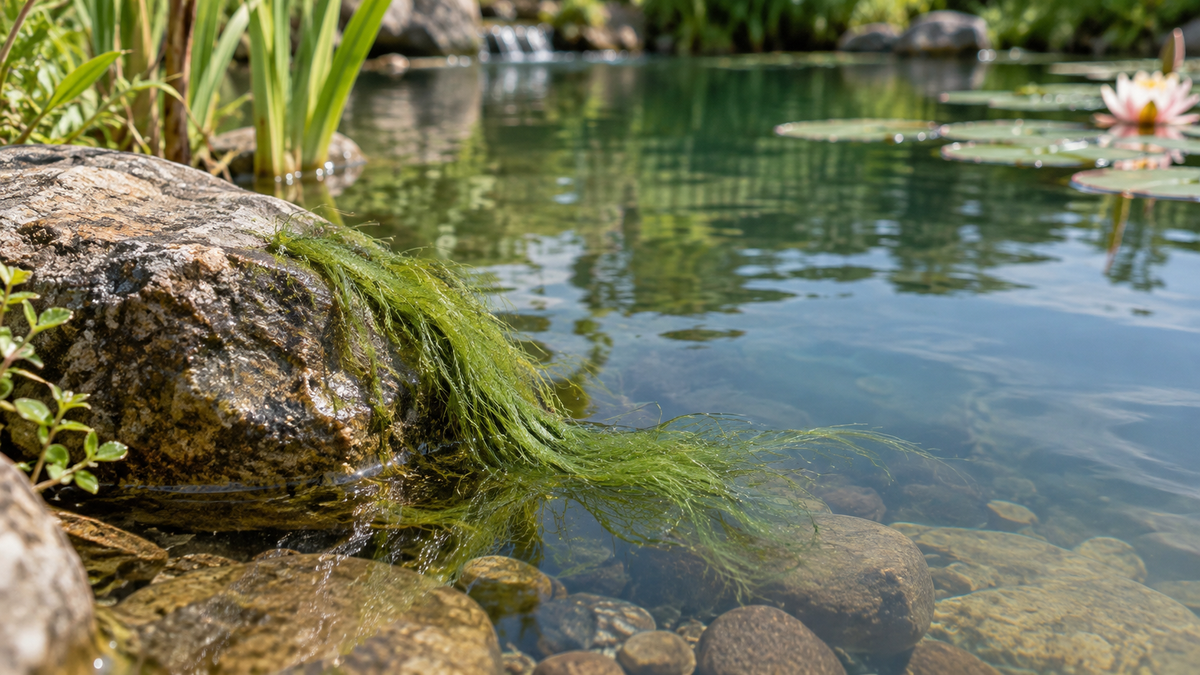
Filamentous algae generally form threads, strands, or mats attached to a support. They are often noticed on rocks, waterfalls, shallow edges, and some plants. This presentation differs from a homogeneous green water in which the coloration seems distributed throughout the volume.
The distinction matters because equipment and products do not all target the same problem. A device intended for suspended organisms does not automatically remove a clump attached to a rock. Similarly, a product chosen for filaments does not become a universal answer to any water discoloration.
Take a close-up photo and an overview before removing the clumps. If you observe an unusual film, accumulations resembling paint, or a situation you do not recognize, avoid contact and ask for identification. Visual appearance alone does not allow you to rule out a risk related to certain aquatic proliferations.
Why does removal alone not always solve the recurrence?
Manual removal exports biomass out of the pond. It is therefore useful, especially to clear a water passage or limit an accumulation. But the surfaces, light, and nutrients remain present. Fragments or new shoots can take advantage of these conditions and reform visible strands.
The good question is: what is feeding this cycle in your pond? Leaves, excess food distributed, fish waste, and certain external inputs contribute to the system's load. Accumulated sediments can also participate in nutrient exchanges. Their importance depends on the pond and the conditions encountered.
A low test result does not prove by itself the absence of inputs. Part of the available elements may already be incorporated into the organisms present. Analyses are valuable, but they must be interpreted with the history, the amount of vegetation, and the maintenance. It is the whole of this information that guides the correction.
Map the areas where the algae return
Mentally divide the pond into a few zones: waterfall, sunny edge, planted area, suction, and deep zone. Photograph the same locations at comparable intervals. This simple mapping helps distinguish highly localized growth from a problem distributed throughout the installation.
| Affected zone | Question to ask | Observation to note |
|---|---|---|
| Waterfall or stream | Do deposits remain stuck between the rocks? | Accumulations and ease of recovery |
| Shallow bank | Are light and inputs significant? | Exposure duration and runoff |
| Around plants | Are dead parts decomposing? | Debris, density, and maintenance |
| Feeding zone | Do the fish really consume everything? | Leftovers and food distribution |
Do not try to make all life disappear from every surface. A living pond carries biological communities. The goal is to control disturbing developments, maintain proper circulation, and protect the uses of the pond. A disproportionate intervention can create more variations than the initial problem.
Remove the clumps without redistributing the waste everywhere
Work by accessible sectors, with a suitable tool that limits dispersion. Avoid unnecessarily stirring up the bottom and the baskets. Collect the detached materials as you go instead of letting them drift toward a hard-to-reach area. Then check the baskets and the mechanical parts of the filter.
Inspect the removed materials so as not to unnecessarily carry away animals present among the filaments. Evacuate them in a way that avoids their return to the pond during the next rain. In large ponds or environments hosting significant wildlife, a gradual intervention may be preferable to a massive operation.
The decomposition of a large amount of organic matter contributes to the oxygen demand. This is one of the reasons to prepare the extraction and monitor the fish. An action that simply makes the green appearance disappear, while leaving the materials in the system, does not necessarily solve the load to be managed afterwards.
Reduce the inputs that can be controlled
Start with food. Observe several feedings, weigh what you give, and check the appetite in the current conditions. A handful varies greatly from one person to another. Water temperature, population, and system capacity must guide the ration, with the indications of the chosen food.
Regularly remove accessible leaves and dead plants. If trees bring a lot of material in the fall, a properly installed protection can simplify maintenance. In aquatic plantings, intervene according to the needs of the plants and the season, maintaining a balanced habitat rather than systematically cleaning everything.
Also examine the surroundings. Water coming from a fertilized lawn, a flower bed, or turned earth should not freely enter the pond. Rains sometimes make these entry paths very visible. Correcting a runoff inflow brings a lasting benefit that repeated applications cannot replace.
What place for Aquipond Greenstab?
Aquipond Greenstab is a reference to examine when the identified problem concerns filamentous algae. Its choice must fit into the previous diagnosis: nature of the algae, actual volume, recent analyses, temperature, and ability to manage detached materials.
Consult the instructions corresponding to the packaging before preparing the application. The currently available sheet contains temperature indications that require careful reading; therefore, do not assume that all winter conditions are compatible. Have the range of use and the calendar adapted to your pond confirmed if any doubt remains.
Respect the dose provided for the treated volume. A recurrence does not justify concentrating the product in an area or freely shortening the interval between applications. Also check the treatments already used and their compatibility. A dated list of interventions avoids overlaps that are difficult to interpret.
Monitoring must combine the presence of filaments, the collected waste, and the behavior of the fish. A visible improvement remains one indicator among others. If the same inputs persist, plan a fundamental correction rather than turning the treatment into the only maintenance routine.
Maintain the organic load with Bacto Maintenance
Aquipond Bacto Maintenance can complement a program oriented toward organic matter management, when the conditions of its instructions are met. This function is different from the mechanical removal of filaments. It does not dispense with taking out leaves, leftovers, and accessible accumulations.
Biological products depend on the conditions of the environment and the intended use. Temperature, oxygenation, filter operation, and the nature of the load count in the result. It would be misleading to present an application as a guarantee of an algae-free pond, regardless of the season and the amount of waste.
If you use several solutions in the same program, ask for an order of intervention compatible with their instructions. Biological maintenance and another action on the water do not automatically combine at the same time. Preparing this sequence helps avoid unnecessary purchases and applications whose benefit becomes difficult to evaluate.
Build a program that you can truly follow
A good program fits on one page. Indicate the sectors to inspect, the parameters to measure, the waste to remove, and the conditions triggering a request for advice. Add the interventions provided by the instructions, with their actual execution date. The regularity of this observation is worth more than a calendar filled with actions without justification.
After each intervention, keep a few comparable elements: photos of the same rocks, temperature, frequency of mechanical cleaning, and approximate amount of material removed. The goal is to spot a trend. Filaments that reappear less quickly or in a more limited area indicate a different evolution from a proliferation that is accelerating everywhere.
If nothing changes, review the hypotheses rather than the dose. The population may have increased, the useful flow may be insufficient, or a nutrient input may have been forgotten. In some cases, the layout or the sizing of the system deserves a revision. A product remains a tool within this whole.
Your one-page program:
- The zones to inspect and photograph, always in the same places.
- The parameters to measure (temperature, pH, KH) with their date.
- The waste to remove: filaments, leaves, food leftovers.
- The interventions provided by the instructions, with their actual date.
- The signs that trigger a request for advice.
Frequently asked questions about recurrences
Do algae always return because I dosed incorrectly?
No. The volume and the dose must be checked, but a persistent source of nutrients or favorable conditions can explain the return. You must also take into account the initial identification: treating a problem different from the one actually present rarely gives a coherent program.
Should I empty the pond to start from scratch?
A complete emptying is not an automatic answer to filaments. It represents a major intervention for the fish, the plants, and the biological balance. Before considering it, examine the possibilities of targeted removal, reduction of inputs, and improvement of circulation with a professional if necessary.
Can we avoid any algae in a living pond?
A goal of control is more useful than a promise of total absence. Define what really bothers you: obstruction, accumulation on a waterfall, excessive maintenance, or degradation of use. This definition allows you to measure a concrete result without pursuing an artificially sterile appearance.
To prepare your Aquipond program: gather photos, the volume, the temperature, and the history of interventions. You will be able to choose an action targeted at filaments and a coherent organic maintenance, while correcting the conditions that favor their return.
Also read
- Green water in a pond: causes and lasting solutions
- Phosphorus in the pond: origins, measurement, and solutions
- How to control algae in my pond?
Unsure about your body of water? If filaments keep reappearing despite maintenance, send us photos of the affected areas and the pond's volume, and we'll help you find the source.
Get a free assessmentSend a photo to an expertSources and technical references
- Penn State Extension — managing nuisance plants and algae in ponds.
- Royal Horticultural Society — pond maintenance.
- Anses — risk assessment of cyanobacteria.
- Aquipond Greenstab and Bacto Maintenance data sheets, consulted on October 10, 2026; application conditions to be confirmed on current instructions.