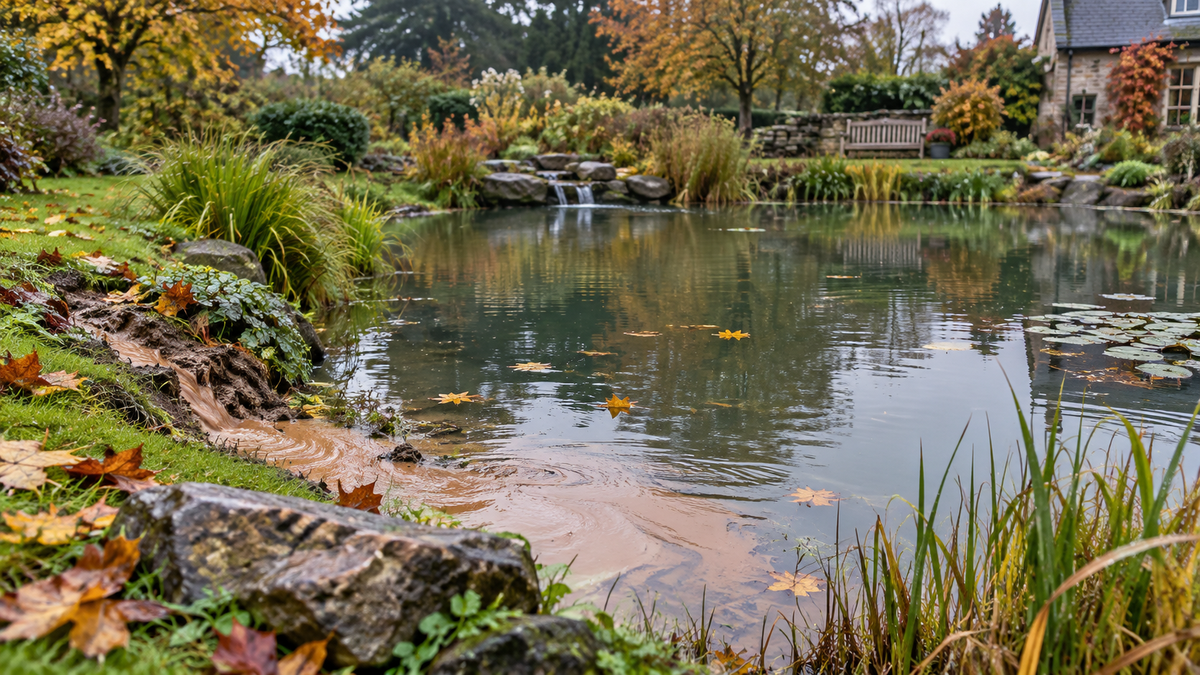
When a pond becomes cloudy after rain, first look for what has entered the water. Soil, plant debris, runoff from a driveway, or a change in the water's composition may all be involved. A clarifier does not correct a persistent influx of mud, and a mineral corrector is not chosen based on the color of the pond.
The right approach is to check the fish and equipment, identify the source of the influx, and then measure the relevant parameters. You can then decide whether you should focus on removing materials, improving the pond's surroundings, or supporting the return to a stable situation with a suitable Aquipond solution.
The first checks after the rain
Approach the pond while paying attention to slippery banks and electrical equipment. Do not work on a powered installation if water has reached an area that should remain dry. A power failure, overflow, or displaced connection deserves a check before handling any product.
Next, observe the fish. Unusual breathing, schooling at the surface, or loss of balance means the situation should be treated as a potentially urgent water quality problem. Check the circulation and aeration, stop feeding, and seek expert advice. Improved clarity alone would not be enough to confirm their safety.
If the fish are behaving normally, photograph the level, color, and visible water inlets. Note the time and when the cloudiness began. This timeline helps distinguish a direct influx of soil from a later development. An observation made before cleaning can prevent losing an important clue.
Follow the path of the water around the pond
Walk around the edges. Look for traces of deposited soil, small ruts, and carried leaves. A slightly sunken bank can allow a large amount of surface water to enter. Paths, patios, and flower beds sometimes become collectors that direct their contents to the lowest point.
Also look at gutters, downspouts, and overflows. Water falling directly into the pond does not follow the same path as water that has washed over a roof, parking lot, or treated surface. The latter can carry substances or materials that a simple pH test will not reveal.
If there is a suspected influx from a fertilized, treated, or contaminated area, do not consider water that has become clear again as proof that the problem is resolved. Prepare a list of potentially relevant substances and ask for advice on testing and the appropriate course of action. An ordinary clarifier is not a universal solution for contamination.
Describe the cloudiness with a simple sample
Take a sample of water in a clean, transparent container that has not had any household products in it. Examine it against a clear background. Particles that settle when left still suggest a settleable fraction. A persistent haze may come from finer materials. This examination helps guide the search without replacing identification or analysis.
| Observed situation | Hypothesis to examine | Diagnostic action |
|---|---|---|
| Brown plume near a bank | Soil influx | Inspect the entry point and slopes |
| Floating debris everywhere | Carried plant materials | Check skimmer baskets and intake screens |
| Uniform beige haze | Fine suspended particles | Compare sample, sediment, and filtration |
| Lasting change after the rains | Repeated influxes or altered parameters | Compare measurements before and after |
Do not conclude that all brown sediment is organic sludge. Soil can contain a large mineral fraction. A biological solution intended for organic waste does not turn sand or clay into clear water. This distinction helps avoid choosing a product that is ill-suited to the materials actually present.
Measure before correcting the KH or pH
A rainy episode can change the mix of waters in the pond. Its effect depends on the volume received, the initial volume, mineralization, and external influxes. A light shower over a large pond is not comparable to a major overflow in a small pond. You should therefore measure rather than assume that the rain has necessarily lowered a parameter.
Record the temperature, pH, KH and, depending on the context, GH as well as the nitrogen compounds useful for monitoring the fish. Use the tests according to their instructions and note their units. A surprising value deserves verification with a clean sample before deciding on a major correction.
KH indicates the water's ability to resist certain acidic changes. GH describes another characteristic, mainly related to calcium and magnesium. These are not two interchangeable names for the same measurement. A confirmed insufficient KH may lead you to consider Aquipond KH+; a cloudy appearance is not enough to justify its use.
Prepare the correction according to the volume and the packaging instructions, monitoring its effect with new measurements. Do not maintain an identical theoretical value for all ponds without taking into account the fish, plants, and equipment. The desired stability must match your actual situation.
Collect materials before they accumulate
Remove leaves and accessible debris from the surface. Check the skimmer baskets, intake screens, and mechanical filtration stages. Heavy rain can quickly bring an unusual load. If flow is reduced, the pond may retain more materials just when they need to be removed.
Target deposits without stirring up the entire bottom. In a small pond, localized collection may be enough for soil deposited near an inlet. In a larger pond, it may be necessary to assess the quantity, nature of the sediment, and removal method with an equipped professional.
Dispose of removed materials somewhere they will not be carried back into the water. Also think about the filter cleaning discharge. Directing it just above the bank can sometimes put the waste back into the pond during the next rain. The exit path deserves as much attention as the influx.
When can Clearwater help after the rain?
Aquipond Clearwater can be considered when particles remain suspended and their mechanical capture is possible. The goal is to make it easier for them to clump together and be collected. You must first control the soil influx; otherwise, the pond will continuously receive new materials while you are trying to remove the previous ones.
Check the volume, tests, and application conditions in the current instructions. Have the filtration and aeration settings, as well as the interval between applications, confirmed for the package size used. Do not improvise a pump shutdown based on instructions found for another clarifier.
Plan to be present to check the mechanical elements after the intervention. Increased particle collection may require appropriate filter maintenance. The product must therefore be integrated into a complete operation: diagnosis, preparation, proper application, extraction, and observation. The bottle alone does not replace this sequence.
Correct the surroundings for the next rain
Once the episode has passed, return to the identified entry points. Depending on the layout, the solution may involve a border, a slope, drainage, or a stormwater management system. The work must respect the constraints of the land and local rules; diverting the problem to a neighboring property is not a solution.
Protect bare soil when compatible with the landscaping project. Avoid storing materials that are easily carried away in direct contact with the bank. If a roof downspout intentionally feeds the pond, assess the entire collection system: quality of surfaces, maintenance, possible settling, and the possibility of diverting questionable water.
Conduct an observation test during the next rain. A correction may sometimes seem satisfactory in dry weather, but allow water through when the flow increases. Photograph the same location to check that the influx has actually decreased. This verification turns a landscaping hypothesis into an observable result.
Before the next rain:
- The skimmer baskets and intake screens are emptied.
- The gutters that join the pond are clean, or diverted.
- The bare soil near the bank is covered or planted.
- The filter cleaning discharge is far from the pond.
- A test kit is ready to measure pH and KH after the episode.
Example of an approach after a storm
Imagine a pond whose bank borders a recently worked flower bed. After the storm, a brown plume comes from this flower bed and the fish behave normally. The first hypothesis is a soil influx, to be confirmed by inspection and sampling. The owner records their tests, removes the debris, and monitors the filter.
The next day, some of the materials have settled near the bank, while a fine haze persists. The approach then consists of removing the accessible deposit, preparing the border correction, and examining the usefulness of a clarification compatible with the measured parameters. This scenario is illustrative: it does not describe a customer result or a guaranteed timeframe.
Frequently asked questions
Should I change all the water after heavy rain?
Not automatically. The action depends on the tests, the fish, and the identified influxes. A suspected contamination requires specific advice. A major drainage also has its constraints and must be prepared, especially regarding the replacement water, its quality, and the changes imposed on the animals.
Does rain replace controlled renewal?
It brings water, but its quantity, path, and composition are not always controlled. It should therefore not be considered equivalent to a prepared renewal with suitable water. A pond regularly fed by rain deserves monitoring of its mineral parameters.
Can I apply a product preventively before every rain shower?
An automatic application is not justified by the rain forecast alone. Instead, prepare the baskets, the drains, and the surroundings. A product is chosen for an identified need and according to its conditions of use, after the checks that allow you to understand the actual state of the pond.
To remember: after the rain, first treat the path of the influxes and the collection of materials. Aquipond solutions then come in according to a precise diagnosis: clarification if it is useful, KH correction if the analysis justifies it.
Read also
- Clean filter, cloudy water: what to check in your pond?
- Filling a pond with rainwater: useful precautions
- Milky water after cleaning the pond: what to do?
Any doubts about your body of water? Send us a photo of the pond and the jar: we will help you identify the influx and the right next steps.
Take the free diagnostic testSend a photo to an expertTechnical sources and references
- Oklahoma State University Extension — common pond problems.
- Mississippi State University Extension — pH and alkalinity.
- Aquipond Clearwater and KH+ fact sheets, accessed October 10, 2026. Check the current instructions before use.