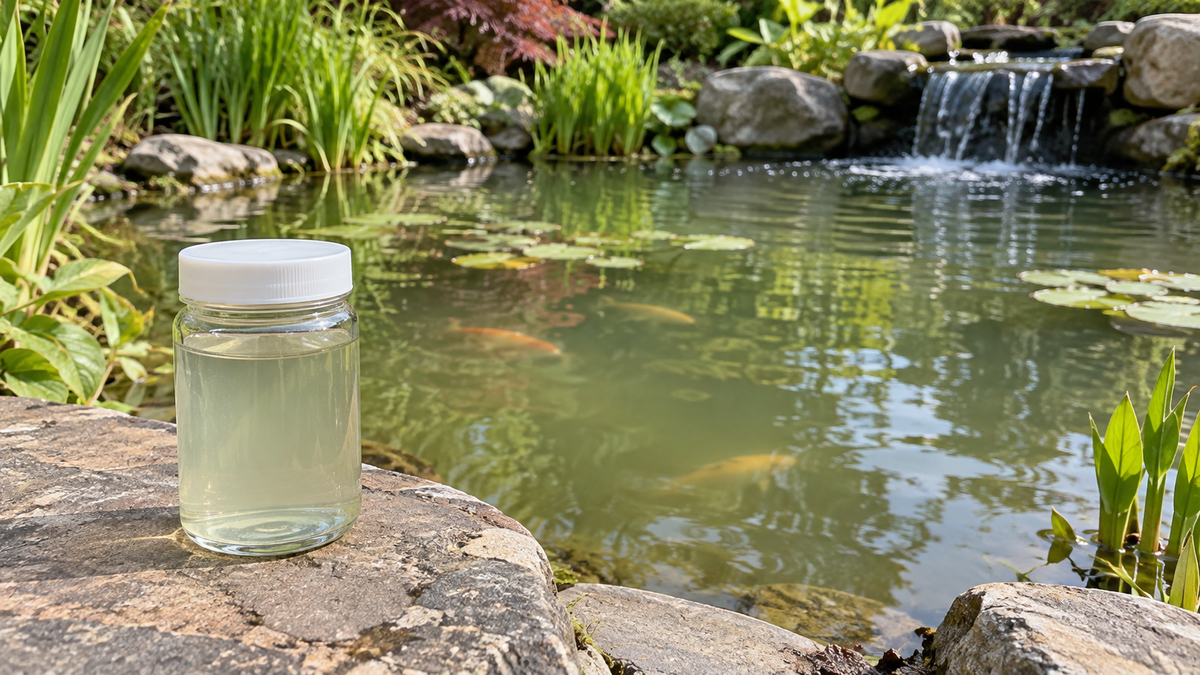
Start by distinguishing transparency and water quality
Clear water can contain problematic concentrations of ammonia or nitrites. Slightly cloudy water can, conversely, correspond to a temporary resuspension after maintenance. Visibility of the bottom provides information, but it does not replace analyses. Also observe the fish: appetite, breathing, unusual grouping near the return, and changes in behavior.
If several fish are breathing abnormally or staying at the surface, their safety is the priority. Immediately check the circulation and aeration, suspend feeding, and ask for expert advice on the analyses and corrective measures. Do not add a clarifier to make the situation visually reassuring: it replaces neither oxygen nor a water diagnosis.
For a turbidity problem without signs of distress, record at least the temperature, pH, KH, and available results regarding nitrogen compounds. Note the units and the name of the test. Two results can only be correctly compared if the method and unit are compatible. Keep this data with a photo taken at the same place.
Identify the turbidity before choosing an action
Take a little water in a clean transparent container, without detergent residue. Look at it against a clear background, then let it rest away from handling. This small examination does not constitute a laboratory analysis. It simply helps describe the problem: uniform color, visible particles, rapid settling at the bottom, or persistent haze.
| Observation | Clue to check | First useful check |
|---|---|---|
| Brown particles that settle | Organic debris or stirred-up sediment | Bottom, planting baskets, fish activity |
| Beige haze after a rain shower | Soil or mineral materials carried in | Runoff from the banks |
| Homogeneous green water | Suspended organisms, including algae | Evolution, nutrients, and adapted filtration |
| Whitish appearance after a major cleaning | Fine particles or possible biological imbalance | Cleaning history and analyses |
Avoid turning a color into a certainty. The same appearance can have several causes, sometimes simultaneous. A recently cleaned pond can contain both substrate dust and organic materials put back into circulation. If the turbidity persists, a more precise examination allows you to decide if clarification really makes sense.
Check the actual path of the water
The power stated on a pump does not exactly describe the flow obtained in your installation. The head, the length of the pipes, the elbows, fouling, and settings modify this flow. A visible water return proves that there is circulation; it does not prove that the entire pond is correctly traversed.
Inspect the inlets and outlets. An intake too close to the return can favor a short circuit, while a distant area accumulates waste. A clogged basket or a partially blocked screen can limit the work of a well-maintained filter. Also check the valves and bypasses: a part of the water sometimes bypasses the intended steps.
Finally, observe the filter media in their housing. Poorly placed elements allow water to pass around them. Over-compacted foam slows down the flow. Conversely, very coarse media will not retain all fine particles. The choice and arrangement of materials must follow the equipment recommendations, without randomly adding a layer that could cause an overflow.
A useful check consists of comparing the system's behavior just after reasonable maintenance, then a few days later. Note the apparent flow, the frequency of clogging, and the place where waste is actually collected. This observation describes the operation better than a simple "the filter is clean" statement.
Do not confuse mechanical cleaning and biological reset
The filter retains waste, but some of its supports also house microorganisms participating in water treatment. Cleaning the mechanical parts when they need it is useful. Systematically stripping all supports, replacing everything, and cleaning the bottom on the same day can disrupt several elements of the balance at once.
Follow the method indicated for your filter and its materials. Organize maintenance to maintain circulation and preserve biological supports as much as possible. After a major intervention, particularly monitor ammonia and nitrites before increasing feeding or adding fish. Transparency does not allow you to confirm that biological filtration has regained its capacity.
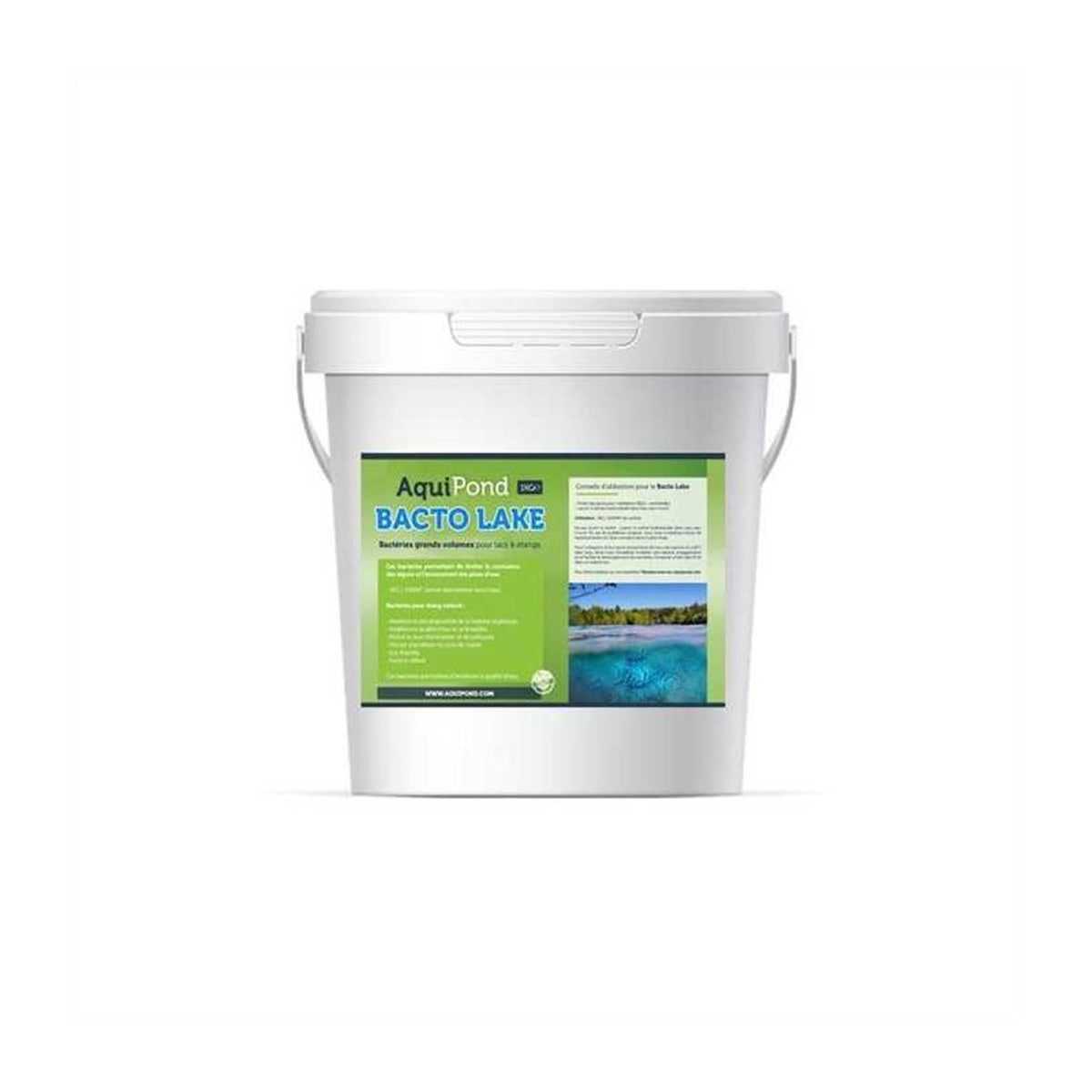
When the organic load remains high despite proper waste collection, Aquipond Bacto Maintenance can be considered in a maintenance program. Its role must remain linked to this objective. It does not replace an undersized filter, insufficient aeration, or the removal of accumulated materials from the compartments.
When to consider clarification with Clearwater?
A clarifier becomes relevant when the diagnosis indicates suspended particles that the installation can then remove. The idea is to promote their grouping to facilitate their capture. You must therefore plan the next step: monitoring filtration, adapted cleaning, and removal of collected materials. Without extraction, the pond retains part of the load you are trying to remove.
Aquipond Clearwater is part of this family of solutions. Before choosing it, check the actual volume of the pond, the nature of the turbidity, the KH and the GH, as well as the conditions of the current instructions. Compatibility with fish, other treatments, and the installation must be confirmed for your situation.
The consulted sheet contains operating and interval indications that require confirmation before defining a precise protocol. Therefore, ask for the instructions corresponding to the received packaging, especially for filtration, aeration, and the time between applications. Do not deduce these settings from an old advice or another reference bearing a similar name.
The desired result must be stated simply: improve the collection of identified particles, then check the evolution. A new application is not decided just because the first day seems disappointing. First examine what was retained, the remaining circulation, and the possibility that a source of turbidity continues to feed the pond.
Remove the inputs that maintain the problem
A filter can work correctly and receive more materials every day than it can remove. Check the leaves, plant debris, uneaten pellets, and soil carried in from the surroundings. In a planted pond, a poorly protected basket or a substrate stirred by the fish can be enough to maintain a regular haze.
Adapt feeding to the actual activity of the fish and the water temperature. Distribute a quantity you can observe, then monitor the leftovers. This control reduces the material unnecessarily introduced into the system. It does not mean starving the fish: it is about measuring the inputs and avoiding automatic feeding according to a habit that has become unsuitable.
After rain, inspect the paths taken by the water around the pond. A slight change in slope, a degraded border, or recently worked soil can explain repeated episodes. Correcting this external input is often more durable than treating the water again after each shower. Take a photo of the runoff when visible to prepare the correction.
Simple monitoring to know if you are progressing
Choose a fixed landmark in the pond, for example a step or a submerged stone, and photograph it under comparable light. Write down the date, recent weather, analyses, feeding, and interventions. The goal is not to produce a complicated file, but to link the changes in the water to concrete events.
Only change a limited number of parameters at a time, except for an emergency requiring immediate action. If you simultaneously change the media, the flow, the food, and several products, it becomes difficult to understand what helped or worsened the situation. A readable program also facilitates exchanges with an advisor.
Prepare four pieces of information before asking for a recommendation: estimated volume and calculation method, population, filtration scheme, and recent analysis results. Add a photo of the pond and the sample. You will thus obtain a proposal better adapted than with the only phrase "my water is not clear".
Your five-point monitoring:
- A photo of the same landmark, under comparable light.
- Temperature, pH, KH, ammonia, and nitrites noted with their units.
- Feeding and observed leftovers.
- Rains and interventions of the week.
- Only one change at a time, except for an emergency.
Frequently asked questions about a cloudy pond despite filtration
Should the pump be replaced immediately?
Not necessarily. Start by checking the intake, pipes, settings, and useful flow. A more powerful pump does not automatically correct a bad water path or insufficient retention. The sizing must consider the entire circuit, the load of the pond, and the characteristics of the equipment.
Does a clarifier replace bottom maintenance?
No. Materials accumulated at the bottom can continue to be resuspended. Their targeted removal and the reduction of inputs remain necessary when this source is identified. The clarifier responds to a need concerning the water in circulation; it does not make all the deposits of a pond disappear.
Should I clean the filter every day?
The frequency depends on the collected load and the installation recommendations. Daily clogging deserves a search for the cause: recent cleaning, soil input, overfeeding, or insufficient filtration surface. Multiplying the washes without understanding the origin of the load turns maintenance into a permanent task.
Your next step: describe the turbidity and check the path of the water. Then consult the Aquipond sheets corresponding to the diagnosis, with your measurements at hand. A treatment chosen for a precise cause is easier to use, monitor, and integrate into durable maintenance.
Read also
- Milky water after pond cleaning: what to do?
- Nitrites in a new pond: understand and act
- Green water in a pond: causes and durable solutions
A doubt about your body of water? Send a photo of the pond and the jar with your latest measurements: we will help you find the cause of the turbidity.
Free diagnosisSend a photo to an expertTechnical sources and references
- OATA — pond fish care and water quality.
- Penn State Extension — the ecology of a pond.
- Aquipond Clearwater and Bacto Maintenance data sheets, consulted on October 10, 2026. For application, the current package insert remains the reference.