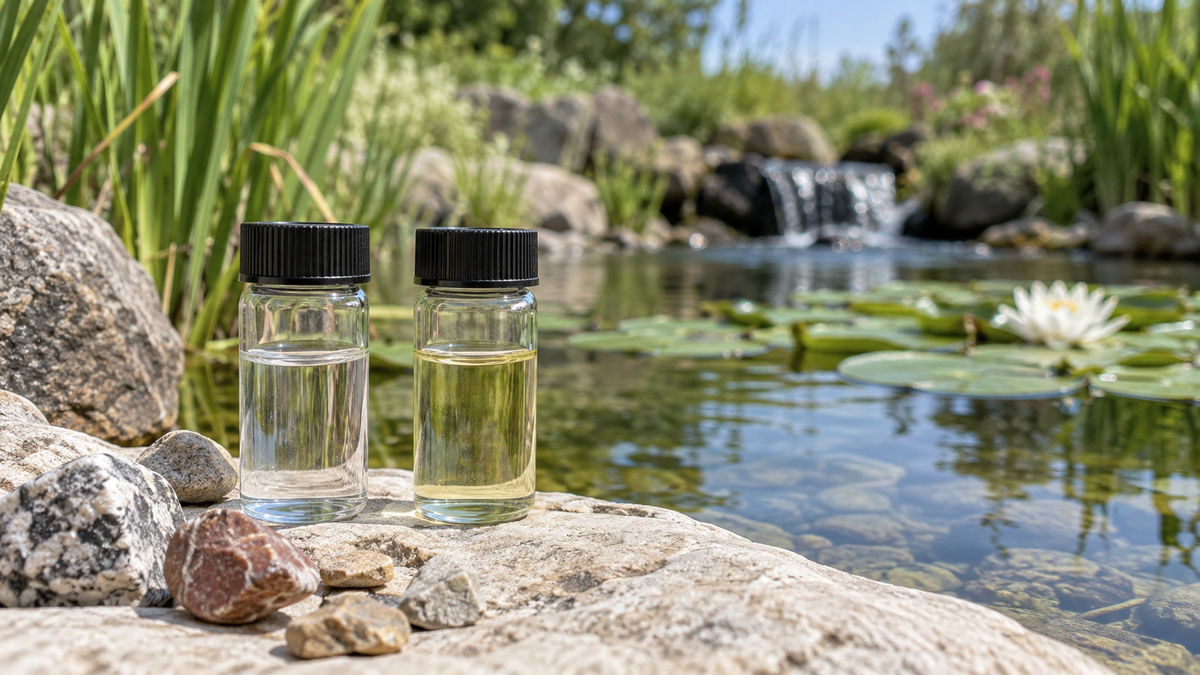
GH and KH describe two different characteristics of pond water. GH mainly indicates its calcium and magnesium content. KH serves as a guide to its buffering capacity, that is, its ability to resist certain pH variations. They are measured separately and corrected according to distinct needs.
This difference explains why a GH+ product does not automatically replace a KH+, even though both refer to hardness. To choose the right Aquipond corrector, start by identifying the result that requires intervention. You will gain precision and avoid adding a product simply because the water appears unbalanced.
Three parameters, three different questions
pH indicates the acidic or basic nature of the water. KH provides information on the alkaline reserve that helps buffer certain variations. GH describes total hardness. The three can be linked to the operation of the pond, but none alone summarizes all its quality.
| Parameter | Question it answers | What it does not allow you to conclude alone |
|---|---|---|
| pH | Is the water acidic or basic at the time of the test? | Its stability throughout the day |
| KH | What alkaline reserve does the test highlight? | The total calcium and magnesium content |
| GH | What total hardness is measured? | The absence of ammonia, nitrites or pollutants |
Water can therefore have an apparently suitable pH at a given time and a KH that deserves special attention. Conversely, a GH measurement does not allow you to say that the pH will remain stable. The monitoring table should keep the three lines instead of grouping them under a single "minerals" mention.
What KH actually means for your pond
In freshwater, bicarbonates and carbonates contribute to alkalinity. The tests commonly used in ponds provide a practical guide to monitor this neutralization capacity. The KH designation is familiar to owners, even if the measurement made by a test can be described more precisely as alkalinity.
Limited buffering capacity leaves less room for certain acidic inputs and pond processes. This does not mean that a low result will necessarily produce a crisis at a given time. It indicates that you need to understand the situation, check the measurement and monitor the conditions before deciding on a correction.
Nitrification and water mixing contribute to the alkalinity balance. A pond regularly supplied with low-mineralized water may thus require special monitoring. The right reflex is to link variations to renewals, rain and system activity, rather than adding a corrector without history.
What GH tells you, and its limits
Calcium and magnesium contribute to total hardness. Their presence is part of the characteristics of the aquatic environment. The needs must, however, be assessed with the population and the type of pond. A value considered practical in one installation does not become a universal target for all species.
GH does not directly provide information on all dissolved elements. Two waters with the same GH can differ by other components. It should therefore not be used as overall proof of quality, nor as a unique indicator to authorize the introduction of fish. The origin of the water and other analyses remain necessary.
Also avoid deducing GH from the presence of white deposits on a border. Their appearance can guide an observation, but only a suitable test gives an actionable measurement. A photograph of a stone does not replace the analysis result when it comes to calculating a mineral correction.
Performing tests that can be compared
Use a clean container, the indicated sample volume and reagents stored according to their instructions. Respect the number of drops, the mixing and the color change criterion. A reading made with the wrong volume of water can produce a misleading value, even when the procedure seems almost identical.
Note the exact unit. Some documents speak of degrees, others of milligrams per liter expressed as calcium carbonate equivalent. These numbers cannot be compared directly. If you transmit your results, photograph the scale and specify the method; this avoids a recommendation based on an assumed unit.
To monitor pH, also indicate the time. Photosynthesis and respiration influence the water balances during the day. Comparing a morning reading to a late afternoon reading without indicating it can give the impression of an unexplained change. The measurement conditions are part of the result.
Choosing KH+ when the need is for KH
Aquipond KH+ is intended to increase KH. It is considered after confirming the result and defining a target suitable for the pond. The choice of packaging then depends on the volume and the usage program, without changing the planned dose to speed up the effect.
The instructions of the product received must specify the application method and the quantity corresponding to the desired adjustment. If it uses a measuring spoon, make sure to use the one that corresponds to the reference. A household spoon or the measurement of another product does not guarantee the same quantity.
Measure after application and mixing according to the appropriate protocol. If the result seems inconsistent, check the calculation, the volume and the test before starting over. A succession of additions based on uncertain readings can create a larger gap than the original problem.
Choosing GH+ when total hardness needs adjustment
Aquipond GH+ answers an objective of increasing GH. It is chosen based on this measurement, with the requirements of the water and the population. It should not be presented as an automatic solution to a pH that is too low or cloudy water.
Prepare the same information as for any correction: volume, initial result, unit, objective and current instructions. If the pond includes a filter, a planted area and connected volumes, determine which volume of water actually participates in the mixing. An estimate based only on the visible surface may be insufficient.
It is possible to need an adjustment of GH and KH, but this situation must be confirmed. Then organize the interventions in a readable and controllable way, with an opinion on their order if necessary. The interest of the two references is to be able to answer two distinct measurements, without imposing a systematic correction of one when only the other requires action.
A correction in five steps:
- Measure KH and GH separately, with the same method and the noted unit.
- Calculate the volume of water actually concerned, including filter and connected areas.
- Choose the corrector that answers the result: if KH is below 7, mineralize first.
- Apply the dose of the instructions, without increasing it to go faster.
- Measure again after mixing, before any new addition.
An example of reading, without a universal dose
Let's take a fictitious example: an owner records a KH of 3 and a GH of 10, in the degrees indicated by their tests. They also notice pH variations and have just added a large amount of low-mineralized water. This data leads to checking the buffering capacity and the measurement method; it does not automatically justify an increase in GH.
In another pond, the two values can be different and the needs of the population also. The reasoning always starts with the interpretation of the result in its context. The numbers of the example serve to show that the parameters can diverge; they do not define a universal target range nor a product dose.
To prepare a recommendation, the owner transmits their volume, the test instructions, the pH times and the origin of the added water. This information allows deciding on an objective, then calculating the application with the instructions of the concerned corrector. The next measurement serves to verify the actual result.
Looking for the cause of a correction that must be repeated
If you have to intervene often, examine the water inputs and outputs. Top-ups after evaporation do not produce exactly the same balance as a replacement of evacuated water. An active overflow during rains, a leak or frequent filter cleaning can change the renewed volumes without always being accounted for.
Also note the changes in population and feeding. The biological operation can evolve with the load of the pond. The objective is to understand a trend, not to attribute each drop to a unique cause. Regular monitoring helps adapt the program with less uncertainty.
A simple maintenance sheet can contain the date, the temperature, the pH with the time, the KH, the GH, the added volumes and the products used. If several people intervene, share this sheet. Corrections made without being noted are a frequent source of confusion in exchanges and calculations.
Before a purchase, check the reagents already available
An old bottle, poorly closed or stored in a very hot shelter can make the reading less reliable. Check the date and the storage conditions indicated by the test manufacturer. If the color change seems ambiguous, have the result confirmed with appropriate equipment. This simple verification can avoid ordering a corrector to answer a value that does not correctly describe the pond water.
Before ordering a corrector:
- The reagents are within their date and have been stored cool.
- KH and GH have been measured separately.
- The unit of each result is noted (°dKH, °f or mg/L).
- The pH is noted with the time of the measurement.
- The actual volume of the pond is calculated.
Frequently asked questions about GH and KH
Does a high GH necessarily mean a high KH?
No. The two parameters can evolve differently depending on the composition of the water. They must be measured separately. An intuition based on so-called hard water does not replace the results necessary to choose a precise corrector.
Can you choose a corrector with a single pH test?
pH alone is not enough to identify the mineral need. Measure at least the parameter you intend to correct and examine the evolution of the pond. A rise or fall in pH can have several explanations; the application must answer a understood cause.
Should you buy KH+ and GH+ together?
Only if the analyses and the objective show a need for both. Keeping reliable tests and knowing the volume of the pond are the first steps. The useful product is the one that answers the measured result, in the conditions provided by its instructions.
To choose your Aquipond corrector: bring two distinct results, KH and GH, accompanied by the pH and the context. This precision allows building a coherent maintenance and verifying that each intervention reaches the desired objective.
Read also
- pH too low in a pond: diagnosis and correction
- pH too high in a pond: causes and solutions
- Filling a pond with rainwater: useful precautions
A doubt about your body of water? Send us your pH, KH and GH results with their units and the volume of the pond: we will indicate the useful corrector, or the absence of correction.
Free diagnosticSend a photo to an expertSources and technical references
- Mississippi State University Extension — pH and alkalinity.
- SRAC, publication 464 — interactions between pH, carbon dioxide, alkalinity, and hardness.
- Aquipond KH+ and GH+ data sheets, consulted on October 10, 2026. The examples are illustrative; the applications follow the current instructions.