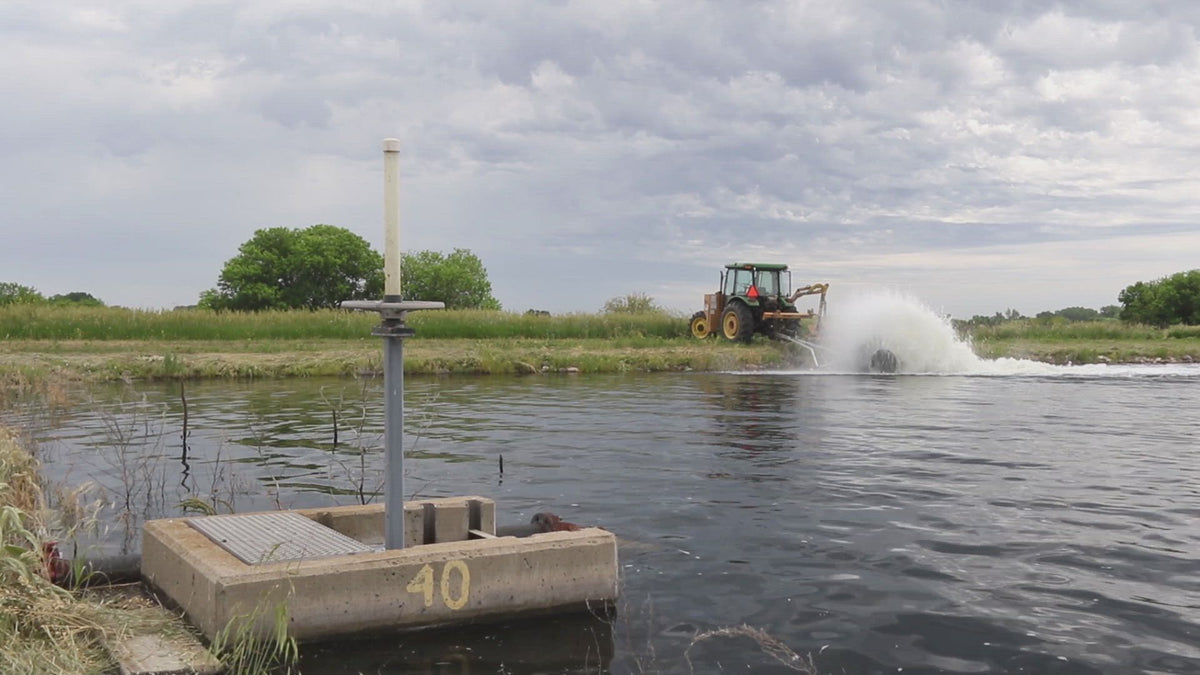
In short: fish gasping for air at the surface in the early morning almost always indicate a lack of oxygen in the pond. Aerate immediately (aerator, pump, waterfall), stop feeding, and do not add any chemical treatments in an emergency. Then, address the causes: water that is too warm, excessive algae, abundant sludge, or too many fish.
How to tell if a pond lacks oxygen?
Dissolved oxygen is the oxygen present in the water in the form of gas, which fish extract through their gills. It is measured in milligrams per litre (mg/L). A pond can lack oxygen without anything being visible during the day, then crash in a few hours. Signs to watch for:
- Fish at the surface in the early morning, with their mouths open, appearing to "gulp" air. This is the most reliable sign. They sometimes gather near the water inlet or waterfall, where the water is better oxygenated.
- Lethargic fish that no longer flee when you approach or stop eating.
- Smell of rotten eggs or sludge: this indicates hydrogen sulphide, produced by anaerobic decomposition at the bottom.
- Sudden change in water colour: very green water that turns brown, grey, or milky in a day or two often indicates that the algae are dying en masse.
- Sudden mortality, often after a heatwave, thunderstorm, or several days of overcast weather, affecting the largest fish first, as they consume the most oxygen.
If you observe any of these signs, go straight to the emergency plan below. The explanations can wait.
What to do in an emergency when fish lack oxygen?
- Aerate immediately. Turn on anything that agitates the water and breaks the surface: an aerator, an upward-facing pump, a fountain, or a waterfall. If you have nothing else, a hose set to a fine spray or a construction pump that draws water from the pond and sprays it into the air can provide real relief. Gas exchange with the air happens at the surface: the more agitated it is, the better the water can replenish its oxygen.
- Stop feeding. Digestion increases the fish's oxygen consumption, and uneaten food decomposes, consuming oxygen. A few days of fasting will not cause any problems for pond fish.
- Do not add any chemical treatments in an emergency. An algaecide that kills algae abruptly causes them to decompose and worsens the oxygen deficiency. Wait until the situation has stabilised before addressing the causes.
- Add fresh water carefully. Cooler water contains more oxygen, but tap water may contain chlorine, and a temperature difference that is too large can stress the fish. Add it as a fine spray, gradually, and limit the volume. Rainwater or well water, if available, is preferable.
- Remove dead fish without delay: their decomposition consumes oxygen and degrades the water.
- Monitor the following night. The danger will return every night as long as the cause persists. Check the fish at daybreak and keep the aeration running continuously.
Your emergency kit for summer:
- An aerator or backup pump ready to plug in.
- A protected outdoor socket and an extension cord suitable for outdoor use.
- A hose with a fine spray nozzle.
- A net for removing dead fish.
- An oxygen meter or oxygen test kit.
- A rainwater storage container, if possible.
Why does a pond lack oxygen?
Warm water contains less oxygen
The maximum amount of oxygen that water can dissolve, called saturation, decreases as the temperature rises. At the same time, fish and bacteria consume more oxygen because their metabolism speeds up in the heat. Summer therefore combines lower supply with higher demand.
| Water temperature | Oxygen at saturation (freshwater, low altitude) |
|---|---|
| 5 °C | approximately 12.8 mg/L |
| 10 °C | approximately 11 mg/L |
| 15 °C | approximately 10 mg/L |
| 20 °C | approximately 9 mg/L |
| 25 °C | approximately 8 mg/L |
| 30 °C | approximately 7.5 mg/L |
These values are theoretical maximums. A real pond is rarely saturated everywhere: it can be supersaturated at the surface in the afternoon and almost depleted of oxygen at the bottom.
Algae and plants respire at night
During the day, plants and algae produce oxygen through photosynthesis. At night, they consume it, like fish and bacteria. The greater the plant biomass, the greater the difference between the afternoon and dawn. Very green water can thus be supersaturated at 5 p.m. and on the verge of asphyxiation at 6 a.m.
Sludge constantly consumes oxygen
At the bottom, bacteria decompose leaves, dead algae, and excrement. This decomposition consumes oxygen day and night. A heavily sludged pond therefore has a permanent oxygen "debt". When oxygen is lacking at the bottom, decomposition continues without oxygen and produces toxic gases such as hydrogen sulphide. The redox potential allows you to monitor this state of oxidation in the environment.
The collapse of an algal bloom
After an algal bloom, a change in weather, a nutrient deficiency, or a treatment can cause the algae to die in a few days. Their decomposition then consumes a large amount of oxygen, just as they stop producing it.
Sudden mixing after a thunderstorm
In summer, a deep pond can stratify: a warm, oxygenated layer at the surface and a cold, oxygen-poor layer at the bottom. Cold rain or a gust of wind can mix these layers and cause oxygen levels to drop throughout the entire volume.
At what oxygen level are fish in danger?
Thresholds depend on the species, temperature, and the condition of the fish. The guidelines below are indicative.
| Dissolved oxygen | Situation for most pond fish |
|---|---|
| More than 6 to 7 mg/L | Comfortable |
| Approximately 5 mg/L | Onset of stress, reduced growth and immune defences |
| Approximately 3 to 5 mg/L | Distress, fish at the surface, needs to be corrected quickly |
| Less than 2 to 3 mg/L | Critical, mortality possible |
Trout and sturgeon have higher requirements than carp, roach, and tench, which tolerate low levels better. But no species can withstand oxygen-poor water for long.
How to measure dissolved oxygen in a pond?
Two methods exist:
- Electronic oxygen meter: a probe submerged in the water provides a value in mg/L and as a percentage of saturation. This is the most practical tool for monitoring a pond over time, provided it is calibrated according to the manufacturer's instructions.
- Colorimetric test: a few reagents produce a colour to compare with a scale. Less precise, but sufficient to check a questionable situation.
The timing of the measurement matters as much as the tool. Measure at daybreak, when the level is at its lowest, and if possible near the bottom. An afternoon measurement at the surface gives a falsely reassuring result. For other water parameters (pH, KH, nitrites), see the water analysis collection.
How to prevent oxygen deficiency in a pond?
Aerate appropriately
A microbubble aerator placed at the bottom draws deep water up to the surface, where it replenishes its oxygen, and breaks stratification. Pro Air models cover ponds from approximately 100 m² to 2,000 to 4,000 m²; for large bodies of water, emulsifiers and surface aerators spray water into the air. The ranges are presented in the aeration and natural pond aeration collections, and our guide explains how to choose the right aerator.
Point of caution: on a deep pond that has never been aerated, do not start a powerful aerator continuously in the middle of a heatwave. The sudden agitation of the oxygen-poor bottom water can cause the very drop you are trying to avoid. Start with a few hours a day and increase gradually, ideally in spring.
Reduce sludge
Less organic matter at the bottom means less oxygen consumed. Remove leaves in autumn and, if sludge has established, specialised bacteria such as Bactovase (100 g/m² for maintenance, two applications per year in spring and autumn) help to decompose it. See how to reduce sludge.
Balance the plants
Submerged oxygenating plants produce oxygen and compete with algae for nutrients. A balanced plant cover is better than water overrun by vegetation: too many plants also means too much nighttime consumption. See the best oxygenating plants.
Adapt the fish stocking level
Each fish consumes oxygen and produces waste. If episodes recur every summer despite aeration, the pond probably has too many fish for its volume. Reduce the population and feed moderately.
Errors to avoid
- Measure oxygen in the afternoon and conclude that everything is fine.
- Turn off the aerator at night because of noise or electricity, when it is actually most useful.
- Treat algae in the middle of a heatwave: their sudden death causes oxygen levels to drop.
- Continue to feed fish that show signs of distress.
- Fill massively with tap water all at once.
- Leave dead fish in the water.
- Ignore an isolated episode: if it has happened once, the conditions that caused it will return.
Frequently asked questions
Why are my fish at the surface in the morning?
Fish that remain at the surface and appear to be gasping for air at daybreak most often lack oxygen. At night, algae and plants consume oxygen instead of producing it, so the level is at its lowest at dawn. Aerate immediately and stop feeding, then look for the cause: heat, excessive algae, abundant sludge, or too many fish.
How to oxygenate a pond naturally?
Submerged plants produce oxygen during the day, a waterfall or fountain increases gas exchange with the air, and shading part of the surface limits the warming of the water. Reducing sludge and the number of fish decreases oxygen consumption. On a heavily stocked or deep pond, these measures are often insufficient in summer and mechanical aeration becomes necessary.
What dissolved oxygen level is needed in a pond?
As a guide, above approximately 6 to 7 mg/L, most pond fish are comfortable. Below approximately 5 mg/L, they begin to suffer, and below 2 to 3 mg/L, the situation becomes critical for most species. Tolerances vary depending on the species, temperature, and the health of the fish.
Should the aerator be left on at night?
Yes, it is actually at night and in the early morning that aeration is most useful, since that is when oxygen is at its lowest. During warm periods, run the aerator at its minimum from sunset to sunrise, ideally continuously.
Why do my fish die after a thunderstorm?
A thunderstorm after a warm period combines several factors: the overcast sky reduces oxygen production by plants and algae, cold rain and wind can abruptly mix the oxygen-poor bottom water with the surface water, and stressed algae can die en masse and then decompose. The drop in oxygen often occurs during the following night.
Read also
- Pond that smells bad: identify the odour and act quickly
- Natural pond maintenance: the month-by-month calendar
- Cyanobacteria in a pond: recognise, protect, treat
Unsure about your body of water? Surface, depth, fish, sludge: we will help you size the aeration and address the causes. Use our free diagnostic tool or send us a photo.