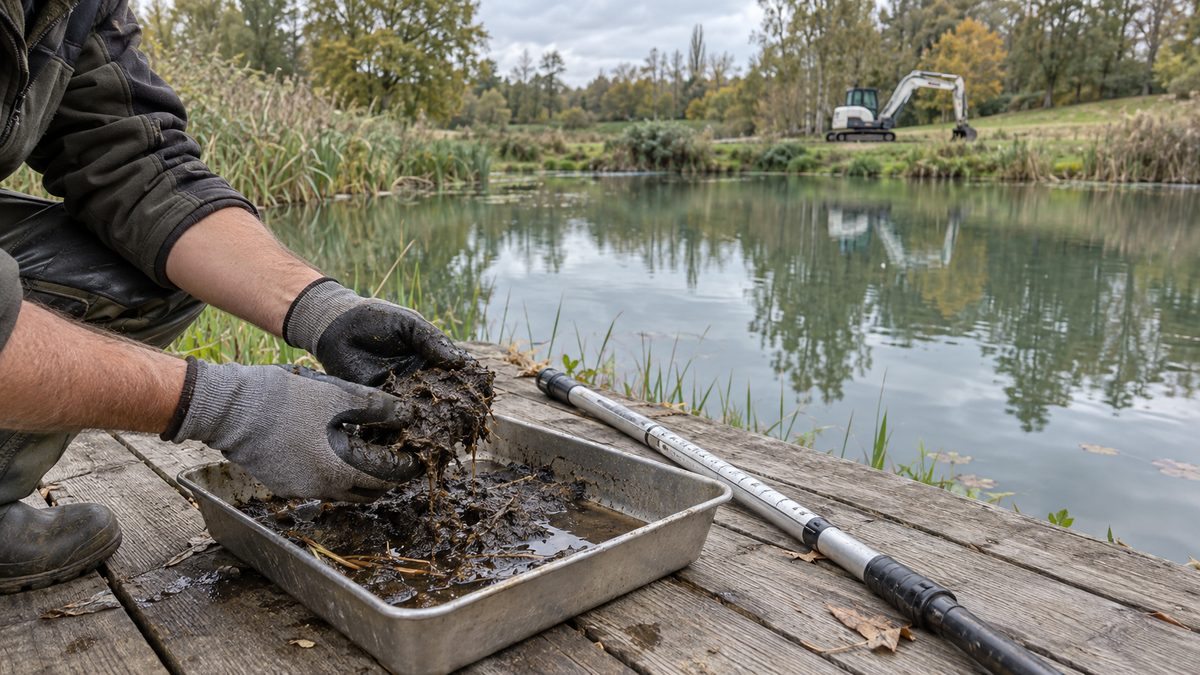
In short: dredging a pond involves removing the sludge that has accumulated at the bottom. Mechanical dredging (draining then excavating, or suction dredging without draining) quickly removes all types of sediment, but is expensive, disturbs wildlife, and may require administrative approval. Bioremediation, using bacteria and chalk, gradually breaks down organic sludge without draining the pond. It is suitable for moderate silting; significant siltation or mineral sludge requires mechanical dredging.
Why do ponds silt up?
All bodies of water naturally fill up. Dead leaves, aquatic plants at the end of the season, algae, and fish and bird droppings settle at the bottom and form organic sludge, which is black and often malodorous. This is added to soil, sand, and clay particles brought in by runoff, bank erosion, or an inlet stream: this is mineral sludge.
Sludge causes several problems. It reduces depth, which heats the water in summer. Its decomposition consumes dissolved oxygen (the amount of oxygen available in the water for fish and beneficial bacteria). Finally, it stores phosphorus, which fuels algae, duckweed, and cyanobacteria. Before choosing a method, identify the type of sludge: our article organic or mineral sludge helps you tell the difference.
How much sludge is in my pond?
Estimating the volume of sludge is the first step, whether you are considering mechanical dredging or bioremediation. The pole method is simple and reliable:
- Prepare a graduated pole (every 5 or 10 cm), long enough to reach the hard bottom. A small disc attached to the end helps you feel the surface of the sludge.
- Mentally or on a sketch, grid the pond, and choose several measurement points spread across the entire surface: edges, central areas, near water inlets, and areas under trees.
- At each point, measure the depth to the surface of the sludge (the first slight resistance), then the depth to the hard bottom (where the pole no longer sinks).
- Calculate the thickness at each point: depth to the hard bottom minus depth to the sludge surface.
- Average the thicknesses and multiply by the surface area of the pond. Example: a 1,000 m² pond with 30 cm of sludge on average contains approximately 1,000 × 0.30 = 300 m³ of sludge.
The more points you use, the more accurate the estimate. Also note the consistency: black, fluid, and odorous sludge is mostly organic; grey or beige, compact sludge that crunches between the fingers is mostly mineral.
How does mechanical dredging work?
Dry dredging: draining and mechanical excavation
The pond is drained, the fish are removed and kept safe, and then the bottom is left to dry out for a period depending on the weather and soil. A mechanical excavator then removes the sludge, which is stored for drying, spread, or removed. This is the most radical method: it also allows the banks to be reprofiled and structures (weir, dam, spillway) to be repaired.
Hydrodredging or suction dredging
A suction dredger, mounted on a boat or operated from the bank, sucks up the sludge mixed with water without draining the pond. The mixture is sent to settling ponds or filter bags (geotubes) where the sludge is dewatered. This technique directly answers the question "how to remove sludge from a pond without draining it?", but it requires specialized equipment and an area to manage the sludge.
What is bioremediation?
Bioremediation entrusts the work to microorganisms. Selected bacteria accelerate the breakdown of organic matter at the bottom into water, gas, and minerals. Natural chalk (calcium carbonate) accompanies them: it stabilizes the pH (the acidity of the water) and the KH (carbonate hardness, which acts as a buffer against pH fluctuations), two conditions favorable to bacterial activity. The addition of lime to pond bottoms is, moreover, an old practice in fish farming.
Bioremediation only works on the organic fraction of the sludge. Sands, silts, and clays are not "digested". Its results are gradual and are assessed over one or more seasons, depending on the initial thickness, the water temperature, and the amount of material that continues to arrive.
Mechanical dredging or bioremediation: what are the differences?
| Criterion | Dry dredging (draining + excavator) | Hydrodredging (suction) | Bioremediation (bacteria + chalk) |
|---|---|---|---|
| Relative cost | High | High to very high | Moderate, spread over time |
| Impact on wildlife | Strong: fish to move, amphibians and invertebrates disturbed | Medium: no draining, but resuspension | Low: the ecosystem remains in place |
| Timeframes | Immediate result after several weeks of work | Fast result, work of a few days to a few weeks | Gradual, over one or more seasons |
| Equipment | Mechanical excavator, machine access, pumps | Suction dredger, settling ponds or geotubes | Manual spreading or from a rowboat |
| Authorizations | Often necessary (draining, work, sludge) | Often necessary (work, sludge) | Generally no specific procedures |
| Sludge management | Large volume to dry, analyze, spread, or remove | Liquid sludge to settle then manage | No sludge to remove |
| Type of sludge treated | Organic and mineral | Organic and mineral | Organic only |
How much does pond dredging cost?
There is no single price: each project is quoted on a quote. The main cost factors are:
- the volume of sludge to remove, hence the usefulness of measuring with a pole;
- accessibility for machines (path, ground bearing capacity, distance from the bank);
- the method chosen and the equipment mobilized;
- sludge management: storage, drying, analysis, transport, and possible treatment in a specialized facility, often the heaviest cost item;
- fish rescue and restocking with water;
- administrative procedures and any studies that may be required;
- restoration of the banks and structures.
Bioremediation has a cost mainly related to the products, proportional to the surface area of the pond, and generates neither sludge nor site costs.
Before requesting a dredging quote, gather:
- The volume of sludge estimated with the pole and a sketch of the measurement points.
- The type of sludge: organic, mineral, or mixed.
- Machine access conditions and ground bearing capacity.
- A possible area to store and dry the sludge.
- The administration's response regarding the procedures to plan.
- A calendar outside the fish and amphibian breeding season.
When is mechanical dredging unavoidable?
- Significant siltation: when the sludge occupies a large part of the water depth, the pond has lost its function and physical removal is required.
- Mineral sludge: sand, silt, and clay do not break down biologically.
- Structures to repair: a leaking dam, a clogged weir, or a spillway that needs to be redone often require draining.
- Suspected polluted sediments (proximity to a road, industry, or former landfill): analysis and supervised management are necessary.
In these cases, bioremediation remains useful after mechanical dredging to slow down re-siltation.
What regulations apply to dredging a pond?
Depending on the country, region, size of the body of water, and its connection to a watercourse, draining and dredging may be subject to declaration or authorization, and sludge management is regulated (analysis, conditions for spreading or removal). Poorly managed draining can send large quantities of sludge downstream and seriously harm the receiving watercourse. Before any work:
- in France, inquire with the water police, at the DDT (or DDTM) of your department;
- in Belgium, contact the competent regional environmental administration and your municipality;
- in other countries, contact local environmental services.
The calendar also counts: breeding seasons for fish and amphibians are generally avoided.
How to carry out bioremediation step by step?
Bioremediation is carried out when the water is warm enough for the bacteria to be active, in practice from spring to autumn.
- Measure the sludge with the pole and check that it is mostly organic.
- Check the pH and KH with a test kit. Low KH makes the pH unstable and slows bacterial activity. See the difference between GH and KH.
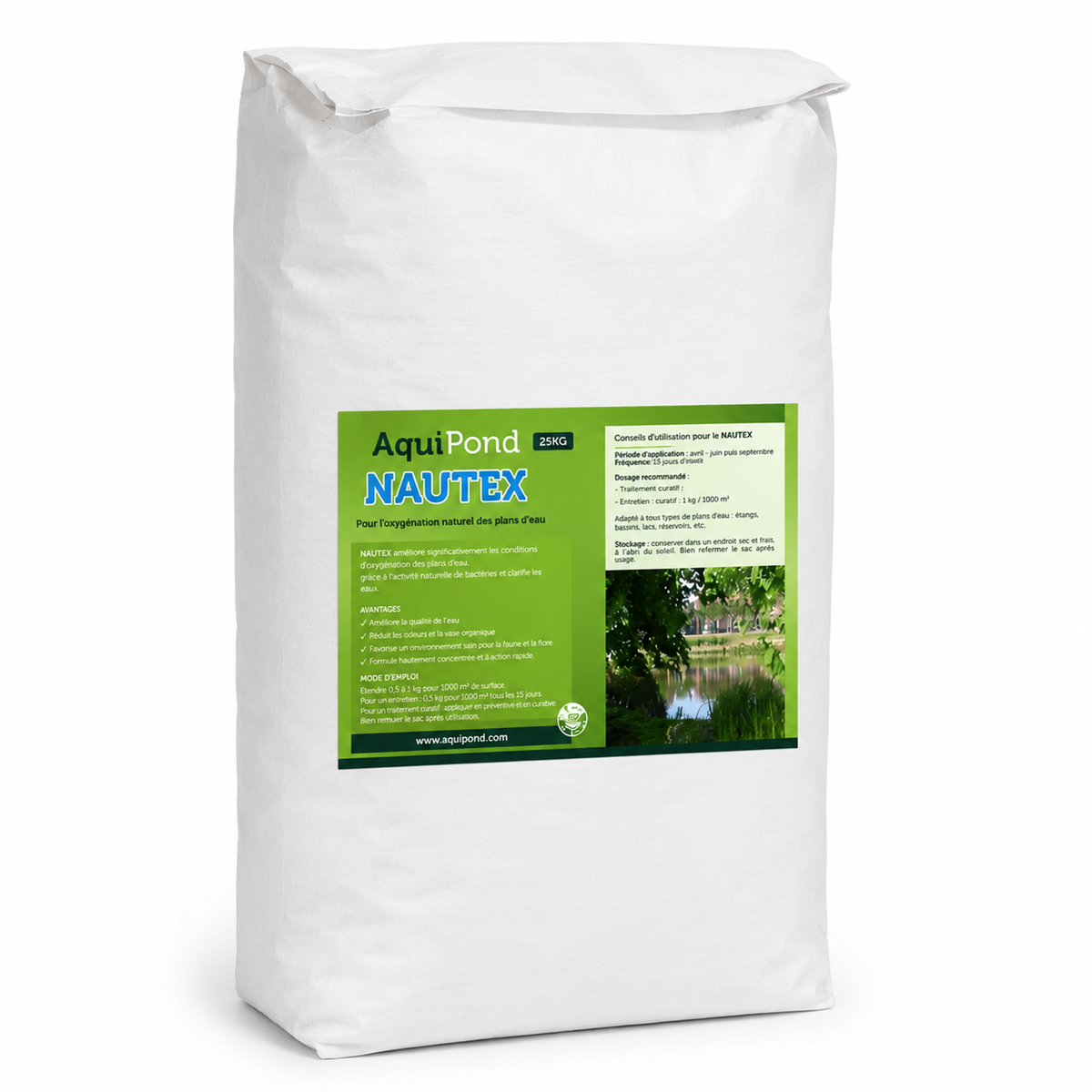
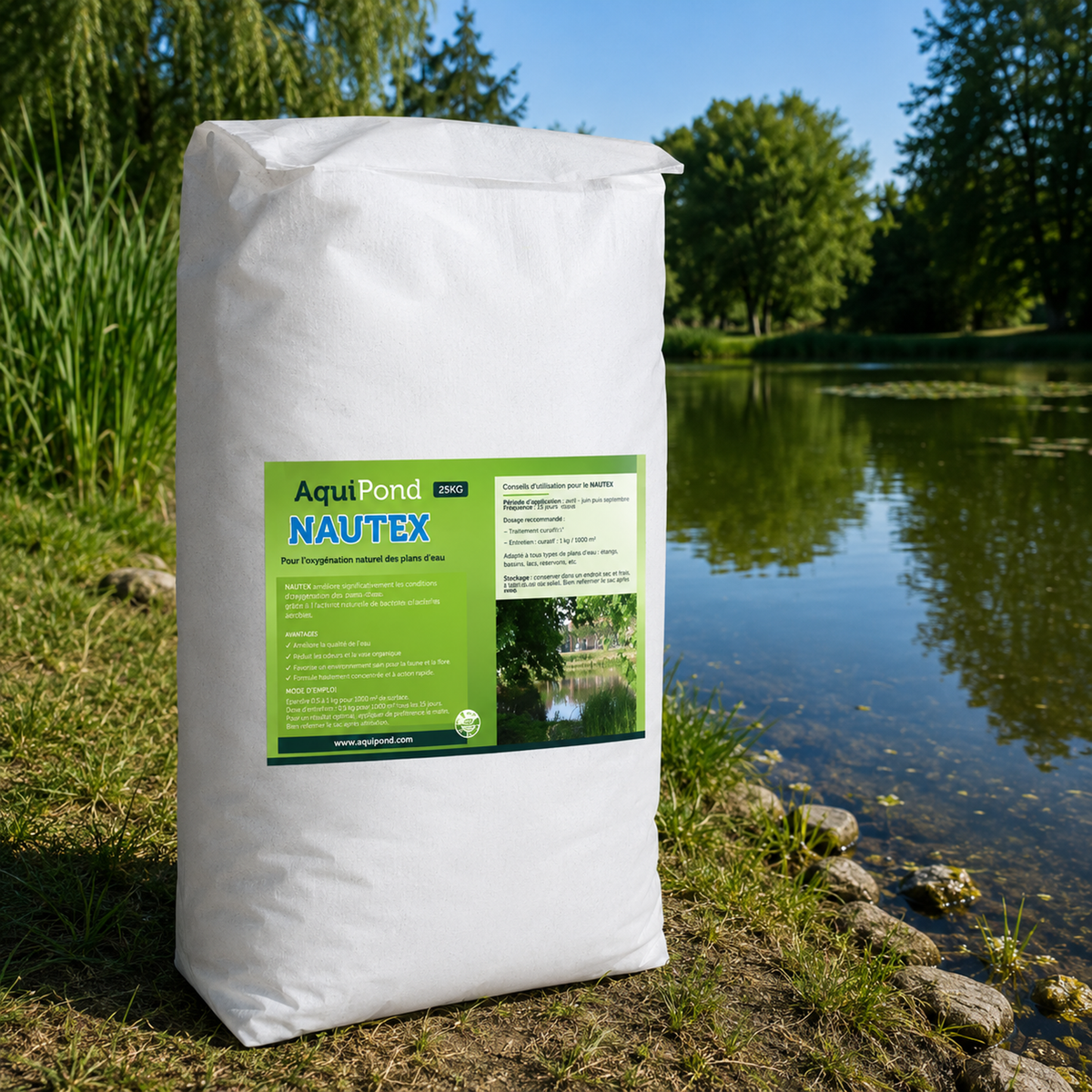
- Spread the chalk. Nautex is used at 100 g/m² for maintenance and 150 to 200 g/m² for correction, spread over the entire surface.
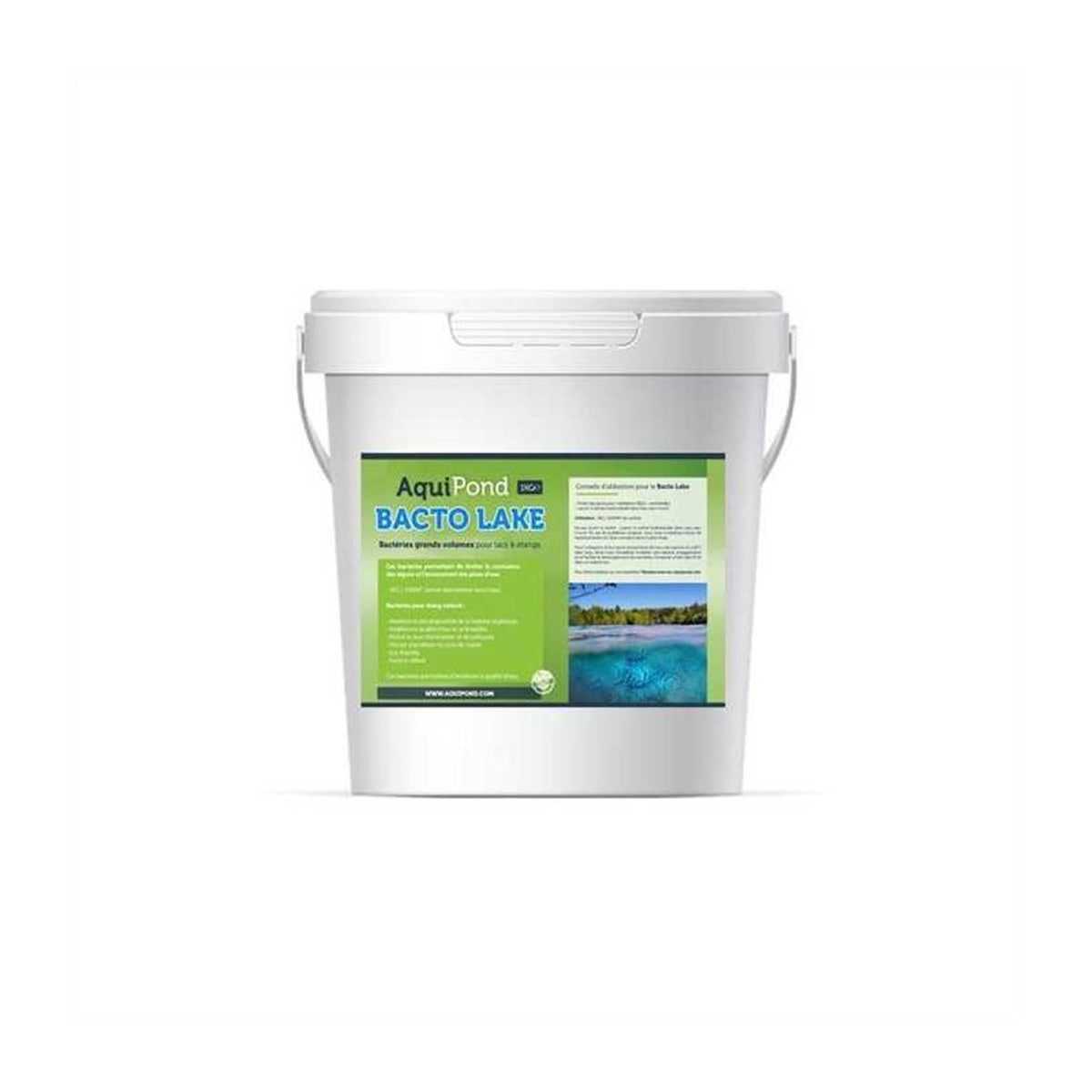
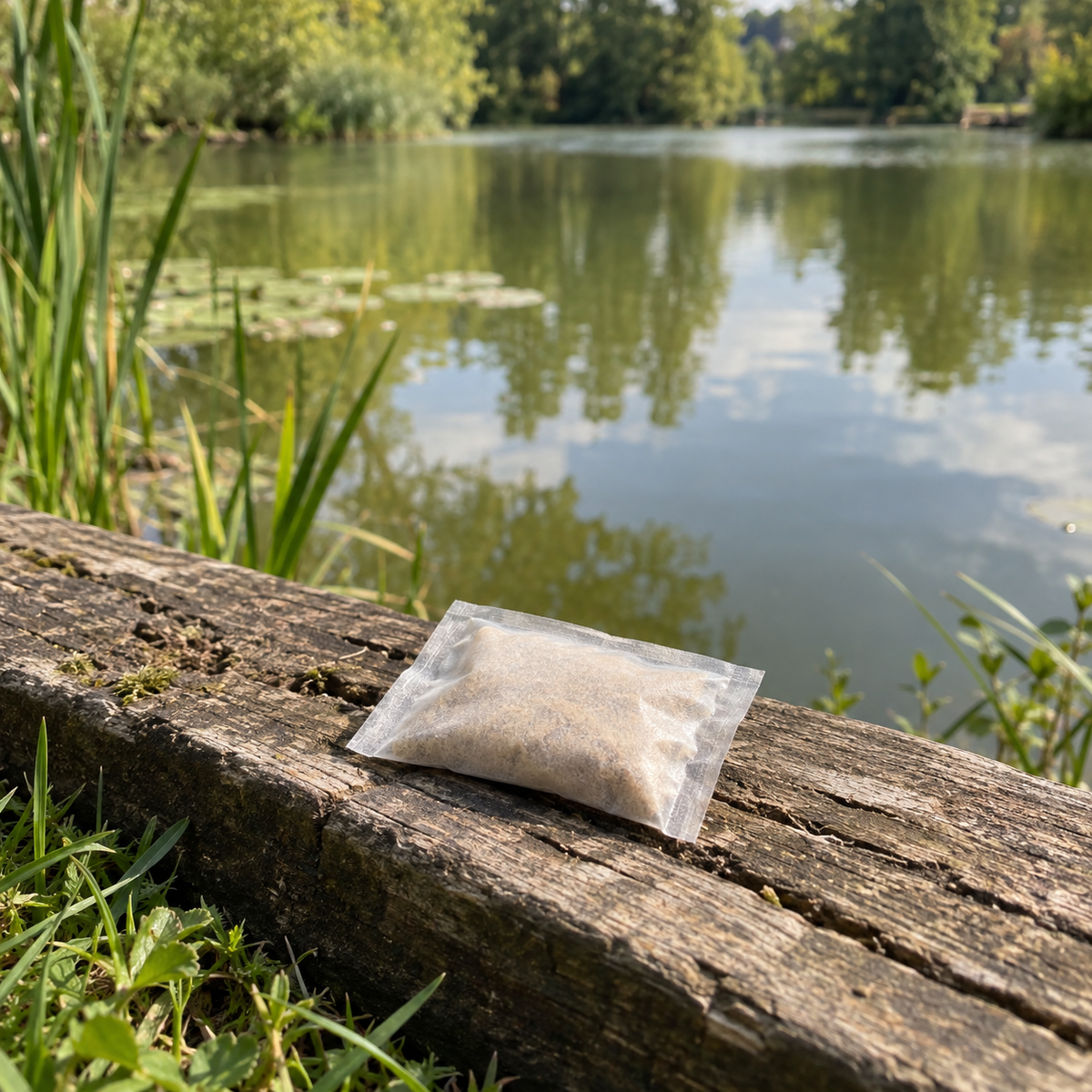
- Spread the bacteria. Bactovase is dosed at 100 g/m² for maintenance and 150 to 200 g/m² for a heavily silted pond (i.e., 1 kg for 5 to 10 m²). Example: a heavily silted 500 m² pond requires 75 to 100 kg. Follow the order and the interval between the two products indicated on their data sheets.
- Repeat twice a year, in spring and autumn, until the desired thickness is achieved, then switch to maintenance doses.
- Reduce inputs: collect leaves (see leaves in the pond in autumn), limit feeding, filter runoff water.
- Measure again every year at the same points to monitor progress.
If siltation is accompanied by duckweed, the duckweed treatment pack combines Nautex, SeDox Max, and Bactovase.
Why combine bioremediation and aeration?
The bacteria that break down sludge most effectively need oxygen. However, the bottom of a silted pond is often lacking, which slows down decomposition and promotes malodorous fermentation and the release of phosphorus. Microbubble aeration diffused near the bottom oxygenates the area where the bacteria work and stirs the water column. To size your equipment, consult how to choose the right aerator.
To go further: our page Bactovase and bioremediation of bodies of water and the collection bacteria to digest sludge.
Errors to avoid
- Draining without checking the regulations and without protecting the watercourse downstream.
- Waiting for a miracle bioremediation on sandy or clayey sludge.
- Underestimating the volume of sludge: without prior measurement, the budget and storage space explode.
- Dredging without treating the causes: without reducing inputs, the pond will fill up again.
- Spreading bacteria in cold water or in an oxygen-deprived bottom.
- Dredging everything at once in a pond rich in biodiversity, when dredging by zones leaves refuges for wildlife.
Frequently asked questions
Can you remove sludge from a pond without draining it?
Yes, in two ways: by hydrodredging, which sucks up the sludge with a dredger, or by bioremediation, which gradually breaks down organic sludge thanks to bacteria and chalk, without machinery or draining.
Does bioremediation work on all types of sludge?
No. It only works on organic sludge (leaves, plant debris, droppings). Mineral sludge composed of sand, silt, or clay must be removed mechanically.
Is authorization required to dredge a pond?
It depends on the country, the size of the pond, and its connection to a watercourse. Draining, dredging, and sludge management may be subject to declaration or authorization. Contact the water police (DDT) in France or the regional administration in Belgium before the work.
How to measure the thickness of sludge in a pond?
With a graduated pole, measure at several points the depth to the sludge surface then to the hard bottom. The difference gives the thickness. The average multiplied by the surface area gives the volume.
How often should sludge be treated with bacteria?
Two applications per year, in spring and autumn, with Bactovase at 150 to 200 g/m² for a heavily silted pond then 100 g/m² for maintenance.
Read also
- Bad-smelling pond: identify the odor and act quickly
- Phosphorus in the pond: sources, measurement and solutions
- Natural pond maintenance: the month-by-month calendar
Unsure about your body of water? Organic or mineral sludge, dredging required or biocrustling sufficient: describe your pond to us. Use our free diagnostic tool or send us a photo.