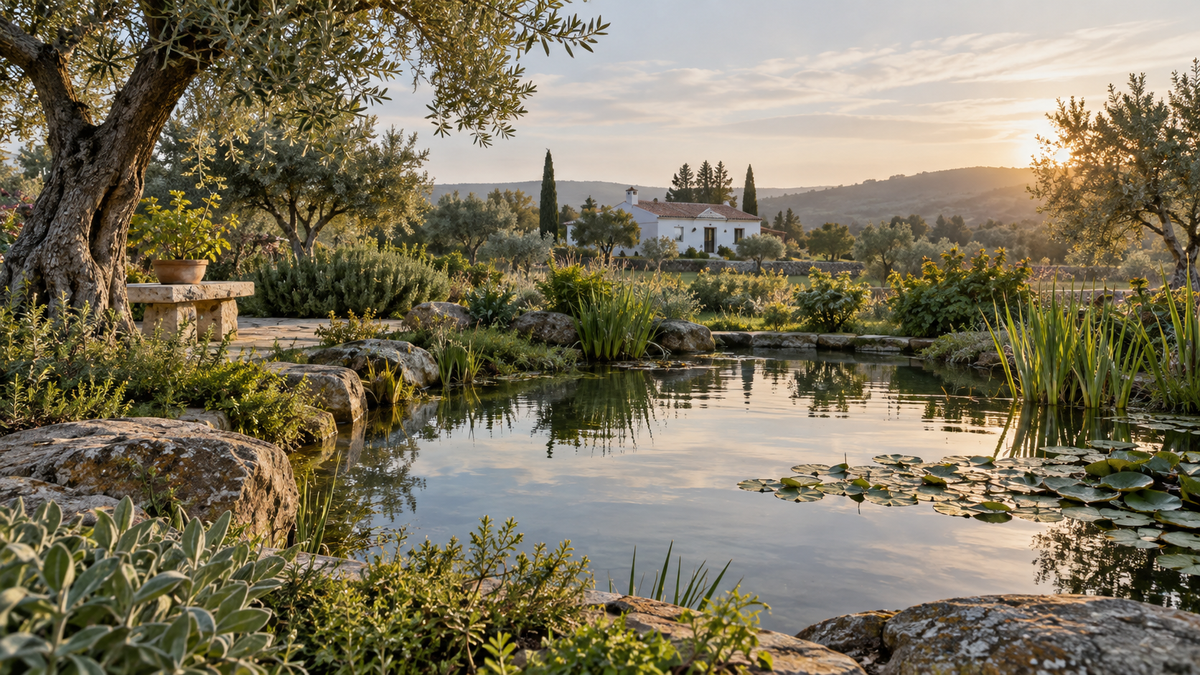
A pond in Portugal can retain algae in winter, especially when the water remains relatively warm and nutrient inputs continue. The month listed on the calendar is not enough to decide on a treatment. The actual water temperature, the region, exposure, and pond operation must guide maintenance.
This situation also concerns other European gardens benefiting from a mild microclimate. To choose the right interventions, you must distinguish the normal presence of aquatic life from a bothersome accumulation, identify the algae, and check the conditions for using the products. Aquipond offers targeted solutions; their usefulness depends on the problem actually observed.
Portugal does not know a single winter
The climate varies between coastal areas, inland regions, and high-altitude areas. Maritime influence, relief, and exposure contribute to these differences, as shown by the IPMA climate resources. A sheltered pond near a house does not necessarily follow the same rhythm as an exposed pond located a few kilometers away.
Air and water temperatures are not interchangeable. Water reacts to its environment according to volume, depth, sun, wind, and circulation. A pleasant afternoon therefore does not indicate on its own that conditions are suitable for a treatment or a resumption of feeding.
Establish a comparable measurement routine: same relevant location, same reading depth, and recorded times. A series of measurements describes a trend more useful than an isolated value. If you entrust the pond to another person, indicate exactly where to take the measurement to maintain consistent observations.
Identify the algae that remain present
Filaments attached to stones do not correspond to the same phenomenon as homogeneous green water. Photograph the material up close, then take a view of the area concerned. Identify if it concentrates in a stream, on a lit bank, or around plants. This localization helps prepare a targeted action.
Do not assume that every green film is filamentous algae. If the appearance is unusual or evokes a layer of paint, avoid contact and ask for identification. Aquatic proliferations are not reliably diagnosed from a single color, and a randomly chosen product can delay the right intervention.
Then define the nuisance: obstruction of a passage, accumulation on the waterfall, difficult-to-remove waste, or rapid extension. A few colonized surfaces in a living pond do not necessarily require a treatment. A measurable objective, such as maintaining the passage of water and limiting accumulations, helps choose a proportionate response.
Why do algae continue to grow?
The seasonal drop in light and temperature does not remove the nutrients already present. Accumulated materials, external inputs, and pond operation remain important. If the fish are still fed, the food also contributes to the load that the installation must manage, with an intensity linked to the ration and the population.
Winter rains can carry debris and soil from the surroundings. A pond that received little runoff during the dry period can discover a new entry path after an intense downpour. Inspecting the banks in wet weather then brings information that a summer visit would not have revealed.
Finally, a change in operation can play a role. A filter stopped too early, a basket left full, or reduced circulation without checking changes the recovery of materials. It is not about keeping all equipment at the same setting all year round, but adapting their operation to the installation and the actual conditions.
Build a winter diagnosis in four observations
| Observation | Why it counts | How to record it |
|---|---|---|
| Water temperature | Conditions the uses and activity of the pond | Value, time, and location |
| Nature and location of algae | Guides the choice of a targeted action | Photos of the same areas |
| Inputs and deposits | Explains part of the recurrences | Leaves, runoff, food |
| Circulation and analyses | Checks the operation and the state of the water | Active equipment, pH, KH, and adapted monitoring |
Add the history of interventions: date, product, quantity, and reason for application. Without this information, a new recommendation risks overlapping with a recent action. Keep the instructions with the products and note the volume used for calculation. An old estimate deserves to be reviewed if the pond has been modified.
Useful mechanical actions during the mild season
Remove accessible accumulations that hinder circulation by limiting dispersion. Work from a safe bank and avoid stirring up deep deposits without preparation. Collect the detached materials, then check the baskets and the mechanical parts of the filtration. Extraction is part of maintenance, even when the fish are less active.
Collect leaves before they accumulate in hard-to-reach areas. A surface protection can be useful if it is correctly installed and regularly monitored. Take into account the fauna and safety around the pond; a loose or uncontrolled net can create other problems.
Also take advantage of suitable periods to correct external inputs. A border that lets soil enter will continue to load the pond as long as the water path exists. The lasting intervention then concerns the layout and drainage, respecting local constraints, rather than a succession of applications after each rain.
Greenstab: check conditions before a winter application
Aquipond Greenstab is a solution to examine for an identified filamentous algae problem. Its use should not be triggered by the mere presence of a mild climate. You must check that the temperature and other pond conditions correspond to the packaging instructions.
The consulted sheet notably includes a temperature indication above 10 °C, as well as a more general formulation that can be confusing. Have the applicable condition confirmed on the current instructions before winter use. A temperature measured at the best time of the day is not enough to represent the entire application period.
If conditions are not suitable, favor management measures that remain relevant: reduction of inputs, targeted removal, and monitoring. Do not increase the dose to compensate for colder water. The product must be used within its intended framework, with monitoring of filtration and materials to be collected.
Bactovase Liquid and organic deposit management
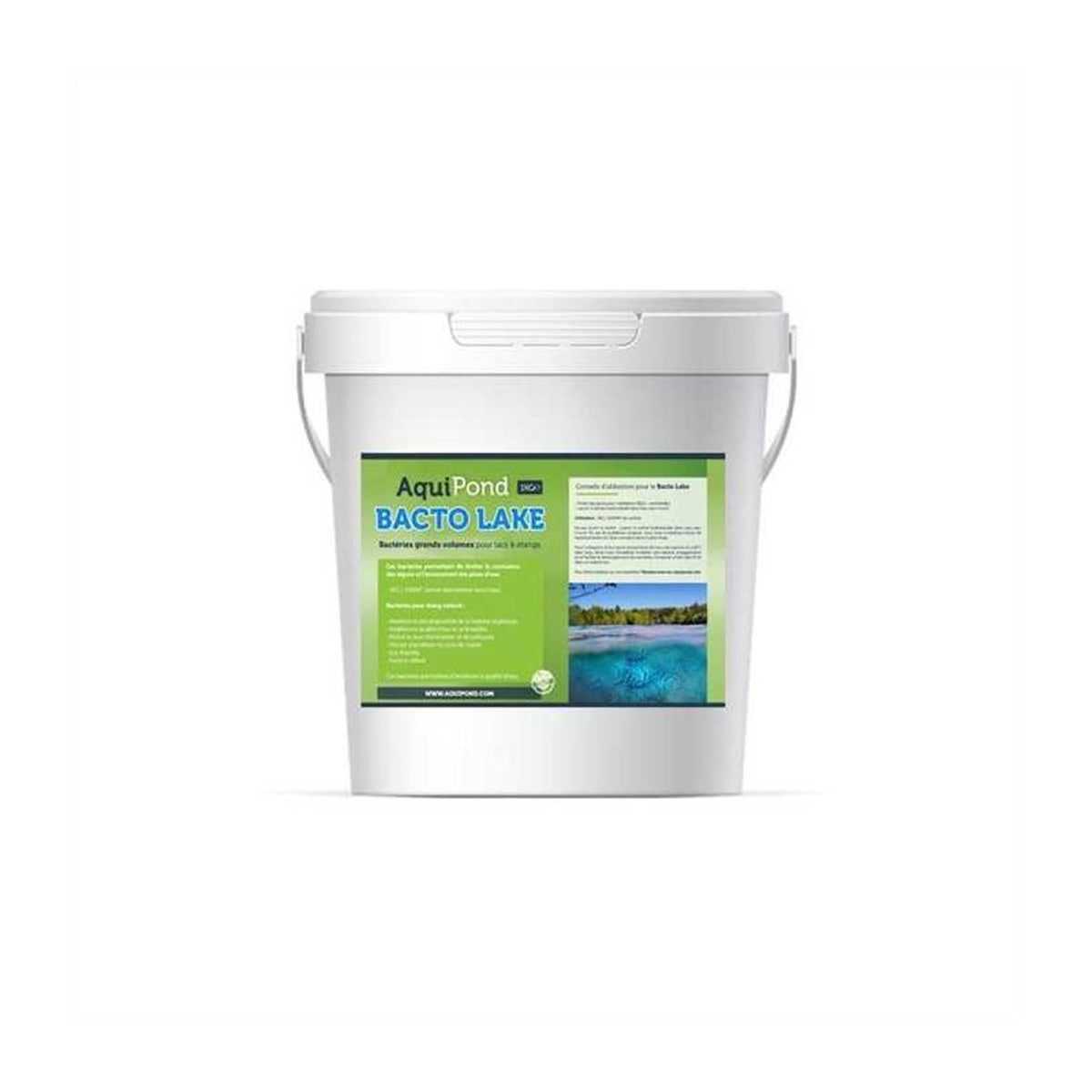
An algae problem can coexist with organic accumulation at the bottom. In this case, Aquipond Bactovase Liquid deserves to be studied for the role indicated in its sheet, in addition to the removal of accessible materials and input management. It does not replace the identification of algae.
Clearly distinguish the organic fraction from mineral deposits. Soil carried from a bank can contain sand or clay that biological maintenance does not make disappear. A coherent program treats separately the entry path, the recovery of materials, and the organic part likely to be concerned.
The mention of autumn or winter maintenance does not mean that the product will give the same result at all temperatures. Confirm the conditions of use for your water and your installation. The liquid and powder formulations must not be dosed by analogy either: their instructions and their quantities are distinct.
When several products are considered, prepare a compatible order with their instructions. Ask for the appropriate sequence if an action on algae and biological maintenance follow each other. A simple schedule, understandable by the person who intervenes on site, is preferable to several treatments applied together without justification.
Adapt maintenance when you don't live on site
For a second home in Portugal, the main difficulty is often the continuity of observations. Prepare a sheet with useful contacts, the equipment diagram, the control points, and the situations requiring a call. The person in charge of monitoring must know how to recognize a change, without having to improvise a technical protocol.
Ask for photos taken from the same locations and a correctly performed temperature measurement. Plan an additional check after a marked weather episode. Avoid starting a new treatment just before a long absence if no one can monitor the circulation, the fish, and the waste recovery.
Food must also be organized. Active fish do not necessarily need the summer ration, and some species require a different reasoning. Give instructions adapted to the population and the food, with a measurable quantity. A vague instruction like "a small handful" quickly becomes variable between intervenors.
The sheet to leave with the person on site:
- Where and at what time to measure the water temperature.
- The three or four locations to photograph, always the same.
- The pump basket and the prefilter to empty, with the frequency.
- The weighed food ration, or the absence of feeding.
- The signs that require a call: fish at the surface, smell, water changing color.
A useful benchmark: compare similar periods
To evaluate maintenance, compare periods whose conditions are sufficiently close. A sunny week followed by several overcast days does not allow attributing all algae variation to the last product applied. Note the weather with the interventions and measurements. You will better distinguish a seasonal change from an effect related to your program, without transforming a simple coincidence into proof of effectiveness.
Frequently asked questions about winter algae in Portugal
Should a pond located in the south be treated all year round?
No. The location is not enough to justify permanent applications. The state of the water, observations, and the conditions of the instructions must trigger useful interventions. Some winters or some locations require above all monitoring and regular mechanical maintenance.
Should I copy the calendar used in Belgium or France?
It can serve as a list of topics to monitor, but the dates do not automatically transpose. Replace decisions based on the month with observable criteria: temperature, fish activity, leaf load, analyses, and equipment operation.
Does an algae flare-up mean the pond is poorly designed?
Not necessarily. Seasonal conditions and inputs may be enough to explain a change. However, a recurring problem warrants an assessment of the whole: circulation, maintenance, population, and surroundings. The diagnosis helps distinguish a one-off adjustment from a structural improvement.
Prepare for winter with Aquipond: record your temperatures, photograph the affected areas, and gather your maintenance history. You will be able to create a program tailored to your Portuguese pond, with interventions chosen for their actual conditions of use.
Read also
- Recurring filamentous algae: address the causes
- Green water in a pond: causes and lasting solutions
- Leaves in the pond: prepare for a cleaner winter
Unsure about your body of water? Send us your photos and temperature readings, even from abroad: we will help you decide whether to take action or simply monitor.
Get a free diagnosisSend a photo to an expertSources and technical references
- IPMA — climate normals and climate diversity of Portugal.
- Royal Horticultural Society — seasonal pond maintenance.
- Aquipond Greenstab and Liquid Bactovase data sheets, consulted on October 10, 2026. The conditions in the current instructions take precedence for application.