The Aquipond dossier · Pond ecology & treatment selection
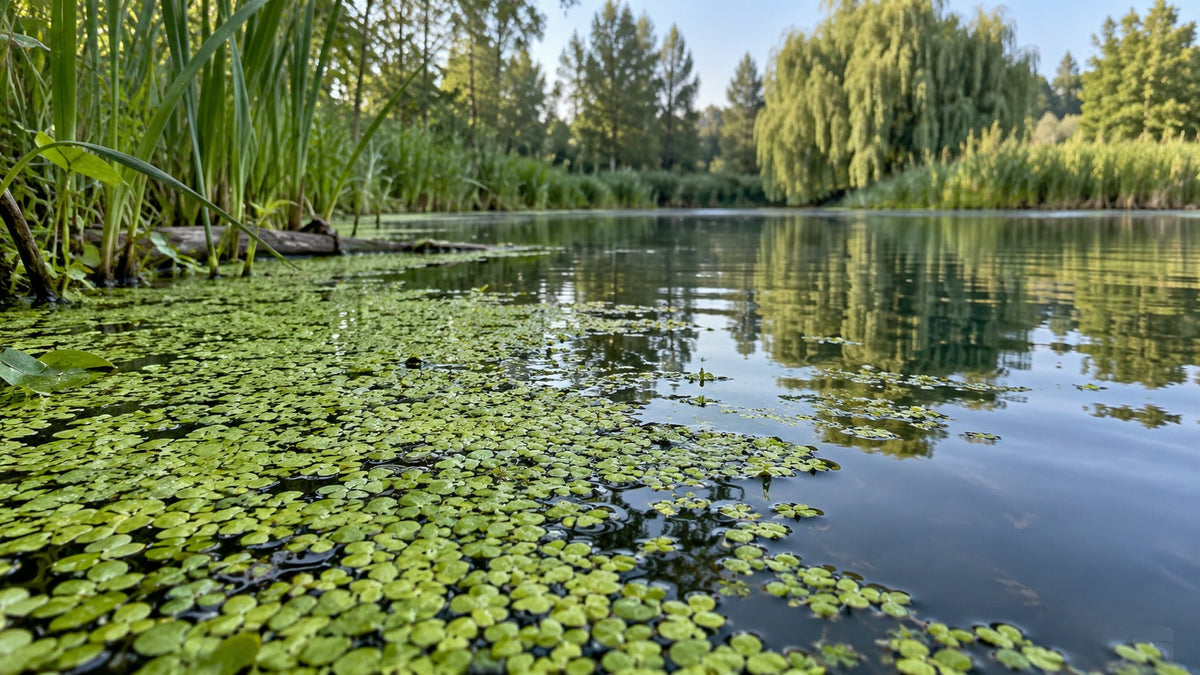
A few small green leaves gather in a cove. Two weeks later, the surface appears to have changed color. When faced with duckweed, the right approach is to understand what is fueling this growth, then to act on several coherent levers.
The Aquipond Duckweed packs combine Nautex, SeDox Max and Bactovase; the two largest sizes also include Blue Lake. Each component serves a specific function. This guide explains their benefits, their limitations and the measures that help you choose the right pack for your pond.
The essentials in one minute
- Duckweed are tiny floating plants. Their multiplication rate explains the mats that seem to appear suddenly.
- Plant removal, nutrient input management and bottom monitoring complement each other.
- SeDox Max targets available phosphorus; Bactovase targets the organic fraction of the sludge; Nautex acts on the carbonate medium when water characteristics justify it.
- Blue Lake filters light underwater. Floating duckweed continues to receive light from above: the dye therefore does not, on its own, constitute a response to their proliferation.
Applied scientific reading: the studies cited describe the biology of duckweed or water management mechanisms. They do not constitute an independent trial demonstrating the effectiveness of the complete pack. The compositions and dosage guidelines come from the Aquipond sheets consulted on October 12, 2026; the product instructions and pond diagnosis take precedence.
1. Duckweed: real plants, several profiles
The word "duckweed" covers several species. Their green part, called the frond, resembles a tiny leaf. Depending on the group, it bears a root, several roots or none. Vegetative multiplication, through the production of daughter fronds, is at the heart of their expansion. [3]
Before treating, take a few elements with a transparent container and observe them on a light background. Small individual discs point toward duckweed. Stretched filaments, a uniform coloration of the water or a film without fronds require another diagnosis. A species name inferred from a general photograph remains uncertain.
| Type | Visual cue | Point of attention |
|---|---|---|
|
Lemna minor Small duckweed |
Flattened frond, generally one root. | Can be confused with other small duckweeds. |
|
Lemna gibba Humped duckweed |
Lower surface often swollen. | Also observe the underside, not just the surface. |
|
Lemna minuta Tiny duckweed |
Small flat fronds, one vein. | A magnifying glass helps distinguish it. |
|
Spirodela polyrhiza Multi-rooted duckweed |
Larger frond, bouquet of roots. | The roots are a useful cue. |
|
Lemna trisulca Three-lobed duckweed |
Elongated and connected elements, often below the surface. | Does not present the same growth habit as a classic floating mat. |
|
Wolffia arrhiza Rootless Wolffia |
Tiny green grains, without roots. | Very small elements: delicate recovery. |
Simplified cues according to the Royal Horticultural Society and FloraWeb; they do not replace a botanical determination. [1] [2]
The presence of duckweed is not, on its own, a sign of poor health. The practical question is that of its abundance, its progression and the use of the body of water. In a natural pond, the goal may be to preserve vegetated areas while avoiding an almost continuous cover. In Belgium, Lemna minuta, of North American origin, is monitored as a non-native species; its identification therefore deserves special attention. [5]
2. How fast can they multiply?
A study comparing 39 clones belonging to 13 species measured, in controlled culture, doubling times between 1.34 and 4.54 days. These results show a remarkable growth potential, but also great variability between clones. They do not allow us to announce that all duckweed systematically double in 24 or 48 hours in all ponds. [4]
To visualize the phenomenon, imagine an initial surface of 1 m² that doubles every three days. It would reach 2 m² on the third day, 8 m² on the ninth and 32 m² on the fifteenth. This calculation assumes that space and resources remain available. It serves to understand a dynamic, without predicting what will happen at your place.

Biomass, number of fronds and cover are not interchangeable. The wind can concentrate in a few hours plants already present in a cove: the appearance changes without their mass having doubled. Conversely, several layers can overlap while the covered surface seems stable.
The consequence for maintenance is simple: observing early allows you to intervene on a quantity that is still manageable. A small area harvested regularly may require less organization than a mass of vegetation that must be removed urgently from the entire body of water. Keep a fixed photography point and also note the wind direction to compare similar situations.
3. What duckweed really loves
Accessible nutrients
Nitrogen and phosphorus participate in the production of new tissues. Their availability and proportion influence growth, without producing an identical response in all species. In an experiment on Lemna minor, Spirodela polyrhiza and Wolffia brasiliensis, the reactions to nutrients and temperature varied between species, with compromises between growth and dormancy. You must therefore avoid turning a single analysis figure into a universal rule. [6]
For your diagnosis, the useful question is: where do the inputs come from and which ones can we reduce? Water inflow after rain, clippings that end up on the bank or poorly adjusted fish feeding do not require the same correction. Note the events that precede a growth resumption rather than accumulating treatments without changing maintenance.
A calm surface and sheltered areas
Stagnant or slow-flowing waters allow the fronds to stay grouped. Coves protected from the wind deserve special monitoring. The Belgian dossier dedicated to Lemna minuta highlights the possible effects of dense mats on light underwater and gas exchanges; a drop in oxygen can result. This situation must be assessed on site, not automatically deduced from a few duckweed on the edge. [5]
Sufficient light, including in partial shade
A shaded pond is not immune. In a 16-day experiment at 22 °C, Lemna minor and Spirodela polyrhiza both grew fastest at the intermediate light intensity tested. Their response to stronger light differed. The species, its origin and its acclimatization matter: "more sun" does not automatically mean "more duckweed". [3]
A favorable temperature and survival possibilities
There is no valid calendar for every European pond. Growth and dormancy strategies differ depending on species and conditions. [6] Organize the monitoring based on the measured temperature and the actually observed resumption. In a region with mild winters, do not consider the change of season as proof that the problem has disappeared. A photograph and a reading at regular intervals will be more useful than a fixed date written several months in advance.
4. Why removing duckweed does not always solve everything
Harvesting brings an immediate benefit: the harvested plants leave the body of water with the nutrients they contain. The Alabama Cooperative Extension recommends combining floating plant management with the reduction of external inputs and reminds that mechanical removal can require perseverance. [7]
But the pond also has a history. Debris has settled at the bottom; part of their nutrients can return to the water. Studies on the sediments of Lake Delavan showed that phosphorus exchanges varied depending on oxygen and pH conditions. The values measured in this lake do not apply to your basin, but the mechanism explains why the bottom deserves to be examined. [8]

A low measurement of dissolved phosphate at a given time does not describe the entire stock present in the plants and sediments. Have specified what your test measures: total phosphorus, orthophosphate, result expressed in phosphorus or phosphate. Comparing different units can lead to a bad diagnosis.
The benefit of a coherent program is to treat regrowth as a medium management problem. You must remove what can be removed, understand what remains and monitor the evolution. It is in this logic that the Aquipond pack is framed.
Your pond turns green again despite harvests?
Start with its surface, its average depth and a few photos of the water and the bottom. You will have the right information to choose the composition and the quantities adapted.
Discover the Duckweed packs Diagnose my pond5. What is each component of the pack used for?
The pack does not gather several products supposed to do the same thing. Its components act on distinct aspects of the body of water. This distinction also allows you to know when to ask for an adjustment.
Lever 1 · Available phosphorus
SeDox Max: immobilize a nutrient that fuels proliferations
According to OASE, SeDox Max fixes dissolved orthophosphate, especially that returned to circulation from the sediments, in insoluble mineral forms. The manufacturer also describes an inorganic carbon input and support for microbial processes thanks to compounds involved in the oxygenation of the sedimentary medium. [9]
In the Duckweed pack, its main benefit is the management of available phosphorus. It does not pick up the fronds and does not substitute for the limitation of new nutrient inputs. Its use makes more sense in a program where you know what you are looking to correct.
The immobilized phosphorus remains physically in the system in another form; this mechanism is different from the export of nutrients by harvesting. The effect on growth also depends on what really limits the plants, continuous inputs and water characteristics. No isolated target concentration guarantees the disappearance of a mat.
The Aquipond sheet provides a sizing guideline of about 5 kg per 100 m³. The volume is therefore essential. A cove of 300 m² and 50 cm average depth does not represent the same volume as a 300 m² pond 1.80 m deep. Do not multiply the inputs by guesswork because the plants remain visible after application.
Consult the sizes and indications of SeDox Max →
Lever 2 · Organic fraction of the bottom
Bactovase: accompany the degradation of organic sludge
The Aquipond sheet describes microorganisms fixed on mineral supports, associated with enzymes and trace elements. The powder settles at the bottom, in contact with the sludge. The desired benefit is a progressive action on its organic fraction.
This precision changes expectations: sand, clay or gravel do not become biodegradable after the addition of bacteria. A hard and mineral bottom, a layer of recent leaves and old organic sludge represent three different situations. Before choosing a quantity, measure the thickness at several places and describe the nature of the deposit.
The transformation of organic matter does not make all its elements disappear: bacteria do not destroy phosphorus. Part of the nutrients can be returned to circulation. The benefit of combining sludge management with phosphorus management rests on this complementarity; it does not constitute proof of a quantified synergy of the pack.
Bactovase requires a medium compatible with microbial activity. Temperature, oxygenation, quantity and nature of the materials to degrade influence the monitoring. An addition of bacteria does not replace a diagnosis in case of distressed fish or strong water degradation.
In the packs, the base is 100 g/m² for one application. The Bactovase data sheet distinguishes between light maintenance and heavy sludge buildup and presents a program of two annual applications. The standard contents of a pack therefore do not automatically represent an entire year of bottom treatment.
See Bactovase and its guidelines according to sludge buildup →
Lever 3 · Carbonate balance
Nautex: calculating chalk based on the water and the bottom
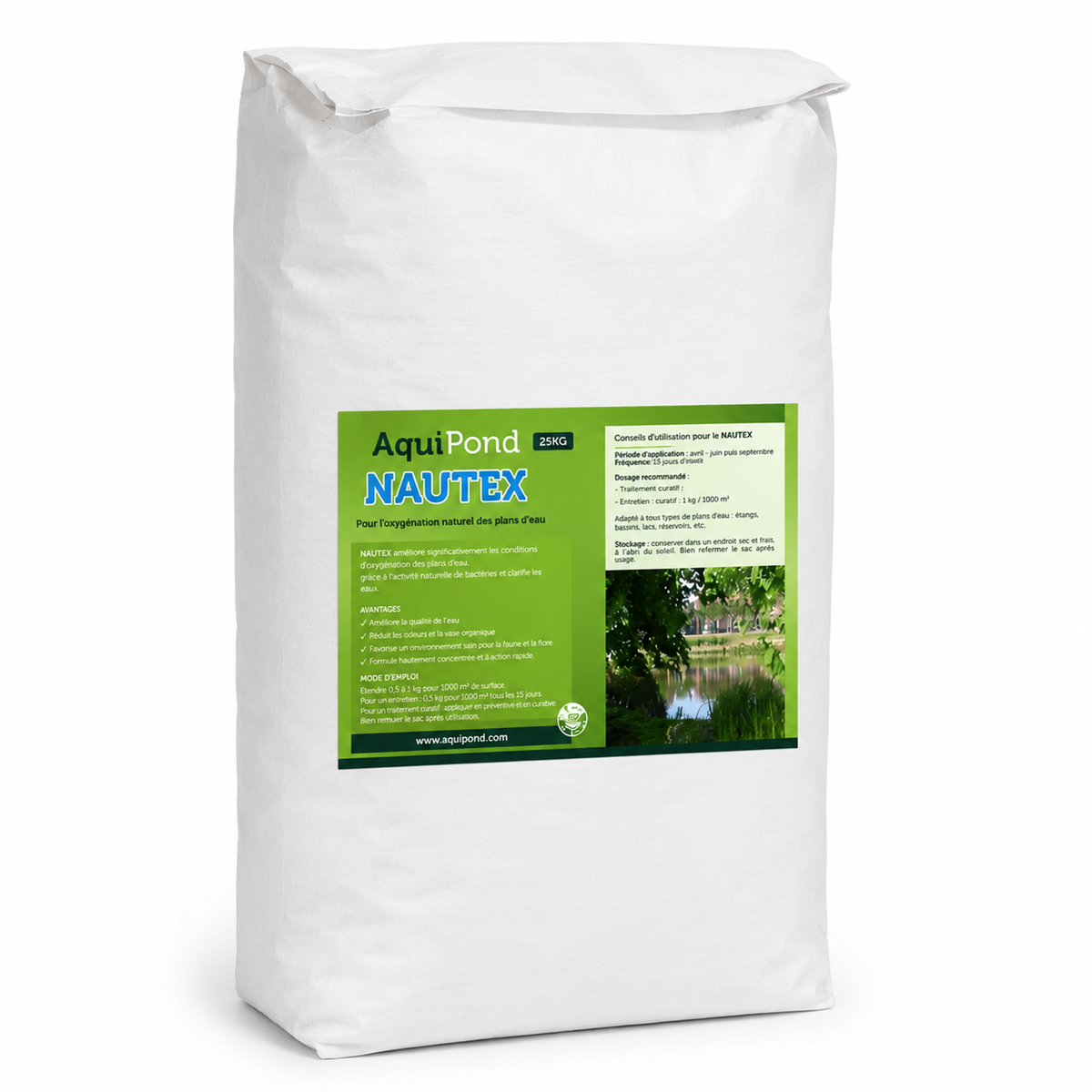
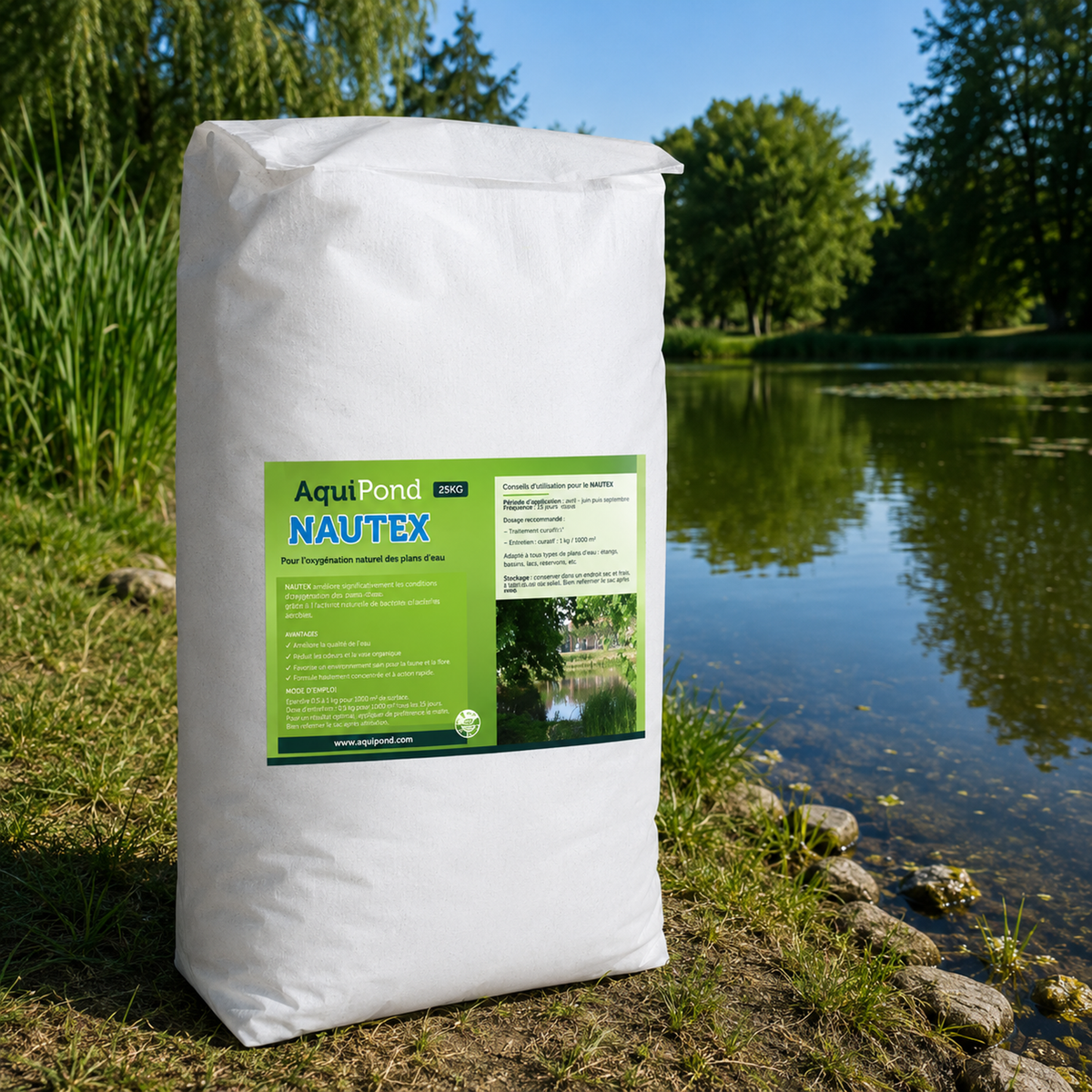
Nautex is a natural chalk based on calcium carbonate, CaCO₃. Its place in the program concerns the maintenance of the environment and its carbonate balance. You must start by knowing the pH, alkalinity — often addressed through the measurement of KH — and the characteristics of the bottom.
The technical outreach work of Virginia Tech explains that calcium carbonate can improve the buffering capacity of insufficiently alkaline waters. They also remind us that liming can increase the availability of certain nutrients and the productivity of a pond. It would therefore be inaccurate to present any addition of chalk as an automatic deprivation of food for duckweed. [10]
Calcium carbonate does not produce oxygen. The support of certain biological processes depends on the conditions of the environment. For a pond that is already well buffered, tailored advice is preferable to the systematic application of an additional quantity.
The base of the pack is 100 g/m², corresponding to the top of the Nautex maintenance guideline. The data sheet distinguishes this use from a corrective treatment, for which the quantities are different. It describes a preparation in suspension in water before distribution over the water surface: follow this preparation and the application conditions shown on the packaging.
Another essential distinction when purchasing: a chalk intended for this use cannot be replaced identically by quicklime or hydrated lime. The name of the material, its formulation and its instructions are part of the technical choice. [10]
Discover Nautex and its packaging →
Complement of the large packs · Light in the water
Blue Lake: a distinct function for submerged vegetation
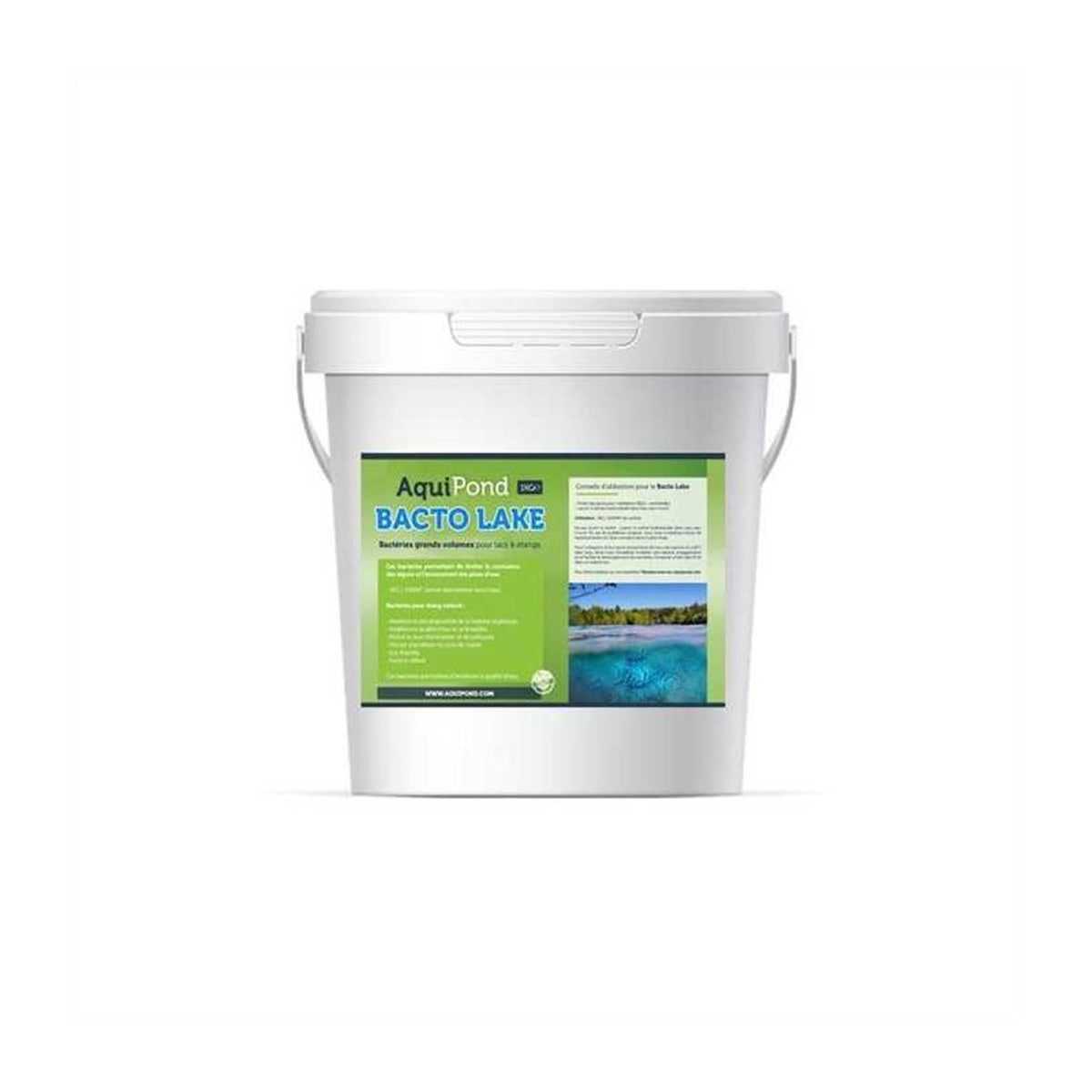
Blue Lake provides a coloration that attenuates part of the light passing through the water. This principle can be useful for certain problems of submerged vegetation or algae, depending on the depth and conditions of the water body. The documents from Oklahoma State University place the dyes in this logic of light management below the surface. [11]

It must be clear on this point: a dye in the water does not screen above the duckweed. The Alabama Cooperative Extension highlights this limit for floating plants. [7] If your only problem is a carpet of duckweed, choose the program based on nutrients, harvesting, and bottom diagnosis; do not base your decision on the color of the water.
In the large packs, Blue Lake may interest owners who also face excessive submerged vegetation and wish for a bluish tint. Its relevance must take into account the plants that one wishes to preserve and the use of the water body. It does not replace any of the management measures described above.
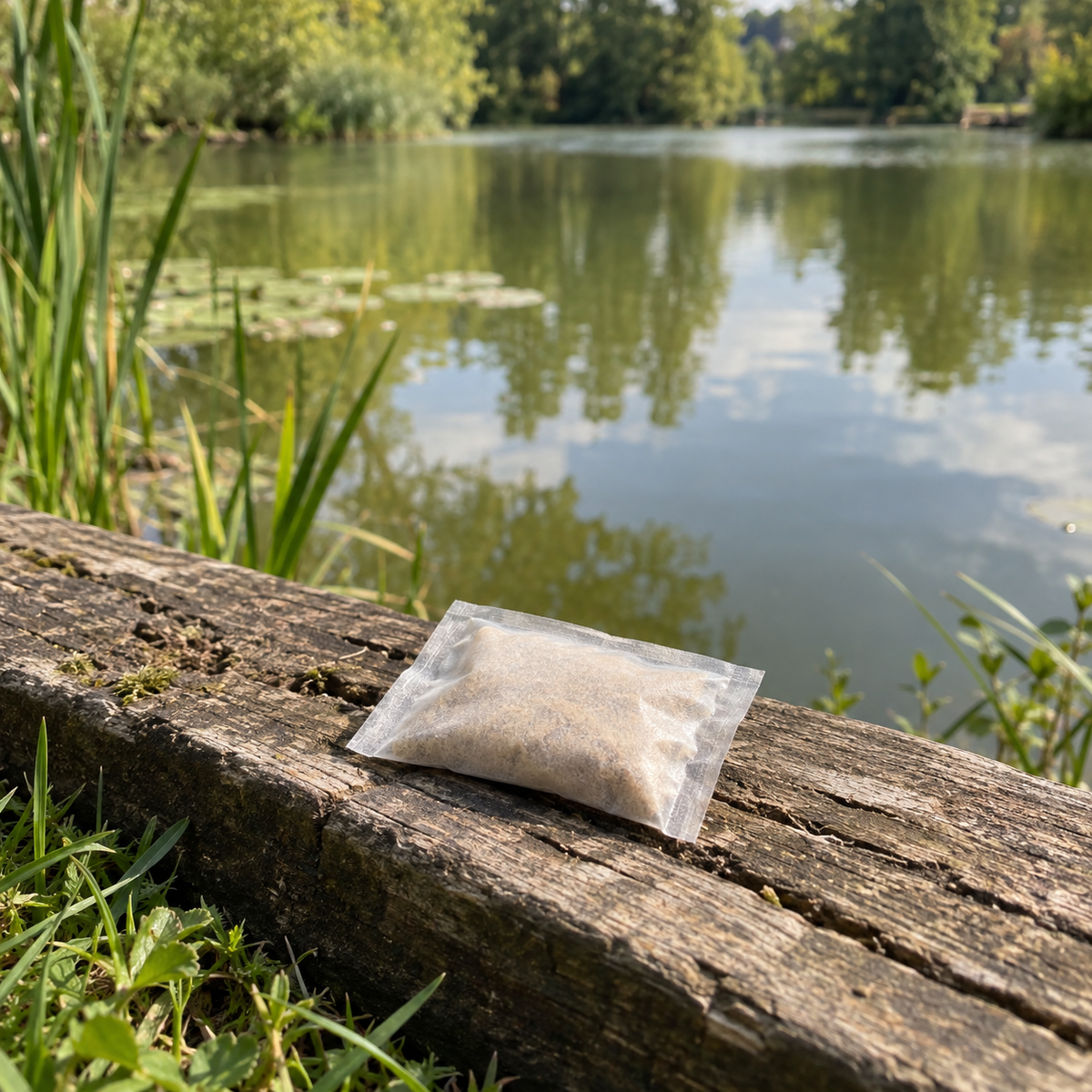
The packaging presented in the pack includes 100 g water-soluble sachets. They are used without opening, according to the instructions, and stored dry. The commercial sheet gives renewal guidelines; do not deduce from them that the same frequency is suitable for all seasons or all water renewals.
See Blue Lake, its sachets and its instructions for use →
6. Which pack for which surface?

The range covers five brackets, up to 1,500 m². The table indicates what is provided, with the associated packaging. It does not prescribe pouring all the contents at once: the quantity actually used depends on the diagnosis and the instructions of each product.
| Displayed surface | Nautex | SeDox Max | Bactovase | Blue Lake |
|---|---|---|---|---|
| Up to 150 m² | 15 kg 10 + 5 kg |
10 kg 2 × 5 kg |
15 kg 10 + 5 kg |
Not included |
| 150 to 300 m² | 30 kg 25 + 5 kg |
15 kg 3 × 5 kg |
30 kg 25 + 5 kg |
Not included |
| 300 to 600 m² | 60 kg 2 × 25 + 10 kg |
30 kg 25 + 5 kg |
60 kg 2 × 25 + 10 kg |
Not included |
| 600 to 1,000 m² | 100 kg 4 × 25 kg |
50 kg 2 × 25 kg |
100 kg 4 × 25 kg |
1 kg 10 sachets |
| 1,000 to 1,500 m² | 150 kg 6 × 25 kg |
75 kg 3 × 25 kg |
150 kg 6 × 25 kg |
2 kg 20 sachets |
Composition noted on the pack sheet on October 12, 2026. The updated formats and prices are on the product page. At the limits between two brackets, check the volume and the needs before choosing the higher format.
Three points to know before ordering
- The pack guidelines use the top of each surface bracket and an average depth of 1 m for the sizing of SeDox Max.
- Nautex is intended on a maintenance basis; Bactovase corresponds to one application at 100 g/m².
- The packaging rounding explains certain differences. The pack up to 150 m² thus contains 10 kg of SeDox Max; this does not mean that 10 kg must necessarily be applied to each pond in this bracket.
All our solutions: duckweed treatments.
The concrete benefit of a pack is to bring together the components in readable quantities, with a common starting point to organize the maintenance. You can prepare the harvest, the application and the monitoring without reconstituting each combination of packaging. For an atypical case, the support retains all its value: it is better to adapt a composition than to oversize the whole.
7. The calculation to make before purchase: surface × depth
The surface determines the extent to be maintained. The volume indicates how much water the pond contains. For a rectangular shape, multiply the length by the width; for an irregular shape, break down the plan into simple zones or use a cartographic survey. Then estimate the average depth from several measurements distributed over the water body, taking into account the surface of the deep and shallow zones. The deepest point is not the average.
Measure the average depth in four steps:
- Take a graduated pole or a weighted meter, and work from a safe bank or a boat.
- Measure every 2 to 3 m along two lines that cross in the center of the pond.
- Also note the shallow areas near the banks: they count in the average.
- Add the measurements and divide by their number: you get a usable average.
Approximate volume in m³ = surface in m² × average depth in m. This formula allows to quickly identify if the commercial base of an average meter is suitable for your situation.

Example: a pond of 300 m²
At 1 m of average depth, the estimated volume is 300 m³. The guideline of 5 kg of SeDox Max for 100 m³ leads to 15 kg, i.e. the quantity provided in the pack 150 to 300 m². For Nautex and Bactovase, 100 g/m² correspond to 30 kg of each on this same surface.
At 1.80 m of average depth, the volume reaches 540 m³. The same indicative calculation leads to 27 kg of SeDox Max. The surface has not changed, but the reference quantity is no longer covered by the 15 kg of the standard pack of this bracket. Then adjust the program.
Finally, if the bottom is heavily sludged, you must separately examine the need for Bactovase and the opportunity of other interventions. Depth is not enough to describe the sludge: clearly distinguish water depth, deposit thickness and its organic or mineral nature.
8. A five-step intervention method
Step 1 — Make a useful assessment
Gather the surface, the average depth, close-up photographs of the plants, an overview and a few observations of the bottom. Record the pH, the KH, the temperature and the available nutrient parameters, with the units and the date. If the carpet is very dense or if the fish show unusual behavior, add a dissolved oxygen measurement and ask for a tailored opinion before treating.
This file avoids decisions made from a single image. It also allows to check if the problem really concerns duckweed or several superimposed vegetations. You can send it via the Aquipond diagnosis.
Step 2 — Remove accessible accumulations
Organize the collection from a safe bank, with a tool adapted to the size of the fronds. Take advantage of natural groupings to facilitate the work, without confusing them with new growth. During the harvest, check for the presence of small animals and put them back in the water. Evacuate the plants to an appropriate valorization area, outside the runoff into the pond, and avoid any transfer to another water body.
The visible result of the collection constitutes your starting point. Photograph the surface after the operation: you will be able to follow the recolonization speed and compare similar periods.
Step 3 — Correct avoidable inputs
Identify the entries of loaded water after a rain and check the maintenance of the banks. Adapt the feeding of the fish and the quantities actually consumed. Avoid that the cutting or trimming waste reaches the pond. A vegetated strip upstream of the runoff can help intercept part of the inputs; it integrates into a management of the land adapted to the site. [7]
Step 4 — Apply each product according to its instructions
Prepare the quantities for your situation and check the conditions of use. A chalk prepared in suspension, a powder intended for the bottom and a water-soluble sachet are not handled in the same way. A pack does not constitute an invitation to mix everything in a bucket. Follow the instructions of each package and have confirmed any sequence that is not specified there.
For deep sites, very loaded with organic matter or subject to a major water renewal, the protocol must be individualized. An aeration can be part of the pond management, depending on the diagnosis; no aeration device is included in the quantities presented here.
Step 5 — Monitor before renewing
Keep a simple journal: date, weather, measurements, quantity harvested, products applied and photographs taken from the same place. Regular passes allow to distinguish a fundamental improvement from a simple displacement of the plants by the wind. If the situation stagnates, redo the diagnosis and the external inputs before increasing a dose.
The monitoring also serves to prepare the next season: which areas recolonize first, what events precede the resumption and what intervention really facilitates the maintenance? These observations give value to the purchased program.
Organize the year: an indicative calendar
Duckweed reacts to the season, but also to the rains, the wind and the inputs. The calendar below serves as a framework: adjust it to your site and to what you observe.
In spring: measure, then act early
As soon as the vegetation resumes, make the assessment: surface, average depth, pH, KH and, if possible, phosphorus. If the KH is less than 7, mineralize first. The first application of Bactovase is done in spring, in contact with the sludge. Harvest the first patches while they are still small: this is the time when the collection requires the least effort.
In summer: harvest and monitor oxygen
Organize regular passes, starting with the areas under the wind where the fronds accumulate. In hot weather, a dense carpet limits the exchanges between the air and the water. Observe the fish early in the morning. An aeration stirs the water and usefully completes the program.
In autumn: second application and fallen leaves
The second application of Bactovase occurs in autumn. Remove the leaves before they sink: by decomposing, they feed the organic sludge, therefore the stock of nutrients for the next year. Our guide leaves in the pond details the good gestures. Then make the balance of the season from your journal.
In winter: prepare for the following season
Review your notes: which areas recolonized first? What events preceded the recovery? Take advantage of this quiet period to correct the identified inputs and prepare the spring quantities with the Aquipond diagnostic.
9. What does credible progress look like?
The first visible improvement may come from the harvest. Managing nutrients and sediments requires longer-term observation. We do not provide a universal timeframe for the disappearance of duckweed: species, existing stocks, inputs, and weather change the trajectory.
| To monitor | Practical method | What this allows you to discuss |
|---|---|---|
| Surface cover | Photos in the same place, with wind and weather noted. | Actual progression or movement of the mats. |
| Recolonization after harvest | Harvest date, estimate of the cleared area, next observation. | Ease of maintaining an open surface. |
| Water parameters | Same tests, same units, and comparable sampling conditions. | Evolution of the environment and relevance of adjustments. |
| Bottom deposit | Measurements at the same points, with a description of the material. | Evolution of the fraction accessible to biological treatment. |
| Maintenance effort | Time spent and approximate volume of harvests. | Concrete benefit for pond management. |
For large ponds, multiple uses, or degraded situations, have these observations interpreted together. More beautiful water does not by itself summarize its ecological state. The goal is a body of water whose maintenance becomes more manageable, with a program that can be explained and adjusted.
10. Frequently asked questions before choosing the pack
Does the pack make duckweed disappear without harvesting?
The removal of accumulations must be planned into the program. The components target characteristics of the environment; they do not replace the removal of already present biomass. The choice of the pack makes full sense with maintenance that also reduces new nutrient inputs.
Can I use only SeDox Max?
A tailored composition may be preferable to the full pack if the diagnostic identifies a specific need. The presence of organic sludge, the carbonate characteristics of the water, and the uses of the pond determine the usefulness of the other components. The diagnostic serves precisely to choose what is relevant.
Why include Blue Lake when it does not block the sun from the duckweed?
The two large packs include this supplement for light management in the water. It may correspond to an associated problem of submerged vegetation and a desire for coloration. For duckweed alone, have its usefulness checked before choosing the composition.
Does a pack cover the whole year?
Not automatically. Bactovase is provided on the basis of a maintenance application, while its sheet presents two applications per year. The use of Blue Lake may also require renewals. Ask for an annual program if you wish to anticipate the quantities and the budget for the entire season.
My pond contains fish: what precautions should I take?
Indicate their presence during the diagnostic, respect the uses and product instructions, and monitor the conditions of the environment. A dense mat, a high organic load, and a high temperature justify special attention to oxygen. In case of visible distress, have the situation assessed quickly before any addition.
What to do for a pond larger than 1,500 m²?
Have a proposal drawn up based on the surface area, volume, and bottom condition. Adding several packs together may overlook a particular need or add an unnecessary component. A precise estimate also facilitates the choice of packaging and the organization of the application.
Is duckweed harmful to the pond?
Not in small quantities: it shelters small fauna and consumes nutrients. An almost continuous mat, however, limits light underwater and can reduce oxygen exchange. The goal is to keep a mostly clear surface, not to remove it from every corner.
What to do with harvested duckweed?
Let it drain for a few hours on the bank so that the small animals can return to the water, then compost it away from runoff into the pond. Never transfer it to another body of water, especially if it could be Lemna minuta, monitored in Belgium as a non-native species.
When to start the duckweed treatment?
As soon as the first patches appear in spring: the quantity to remove is still small and the program has the whole season to work. First assess the situation (surface, average depth, pH, KH), then follow the indicative calendar presented above.
Choose a pack tailored to your pond
You now know the function of each component and the measurements to gather. Compare the five formats to organize your maintenance, or send the characteristics of your pond to adapt the quantities.
Choose my Duckweed Pack Get an Aquipond diagnosticTo go deeper: our general guide on duckweed and phosphorus in the pond: origins, measurement, and solutions.
Also read
Scientific and technical sources
The references below support the explained mechanisms. The diagrams are Aquipond educational creations; no image is presented as a before/after result. The commercial composition and usage guidelines come from the five Aquipond sheets linked in the article.
- Royal Horticultural Society. Duckweed. Identification markers of several duckweeds.
- FloraWeb — Bundesamt für Naturschutz. Wolffia arrhiza. Botanical description and ecology.
- Strzałek, M. & Kufel, L. (2021). Light intensity drives different growth strategies in two duckweed species: Lemna minor L. and Spirodela polyrhiza (L.) Schleiden. PeerJ, 9, e12698. Growth experiment under controlled light conditions.
- Ziegler, P., Adelmann, K., Zimmer, S., Schmidt, C. & Appenroth, K.-J. (2015). Relative in vitro growth rates of duckweeds (Lemnaceae) – the most rapidly growing higher plants. Plant Biology, 17, supplement 1, 33–41. Comparison of 39 clones and 13 species.
- Belgian Forum on Invasive Species. Lemna minuta — Harmonia. Presence in Belgium and possible ecological effects of dense mats.
- McCann, M. J. (2016). Response diversity of free-floating plants to nutrient stoichiometry and temperature: growth and resting body formation. PeerJ, 4, e1781. Experimental responses to nutrients and temperature.
- Alabama Cooperative Extension System. Aquatic Vegetation Identification & Control: Duckweed, Watermeal, Mosquito Fern, Common Salvinia, & Giant Salvinia. Management of inputs, harvest, and limits of dyes for floating plants. American pesticide recommendations are not included here.
- James, W. F., Barko, J. W. & Field, S. J. (1996). Phosphorus mobilization from littoral sediments of an inlet region in Lake Delavan, Wisconsin. Archiv für Hydrobiologie, USGS notice. Experiments on phosphorus exchange with sediments.
- OASE. SeDox Max — 10 kg INT. Manufacturer documentation on claimed mechanisms; this is not an independent study of the pack.
- Virginia Cooperative Extension, Virginia Tech. Liming Farm and Recreational Ponds, CNRE-126. Alkalinity, calcium carbonate, and the importance of analyses before liming.
- Beem, M., Oklahoma State University (2023). Dyes for Pond Weed Management, NREM-9224. Scope and conditions of use of dyes for bodies of water.
Written by: the Aquipond team. Dossier prepared on October 12, 2026. This guide helps to understand and size an intervention; for a specific site, the analysis of the water, sediments, and uses remains decisive.