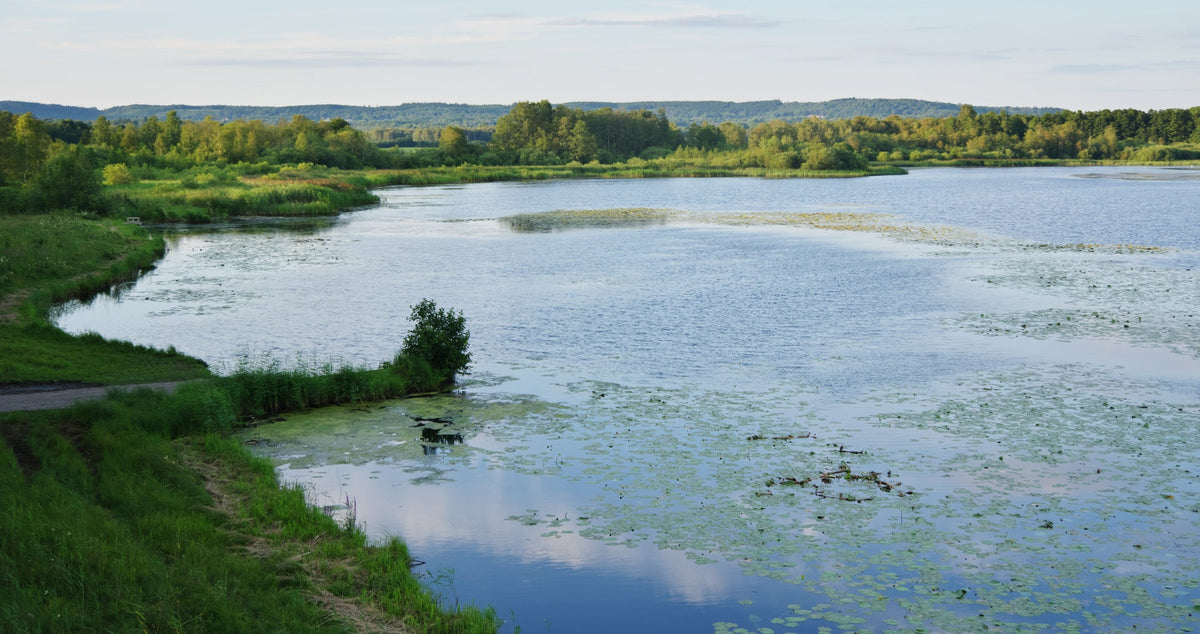
In short: green pond water is almost always due to phytoplankton, microscopic algae suspended in the water that multiply when the water contains too many nutrients (especially phosphorus), receives plenty of light, and warms up. The sustainable solution is to reduce these nutrients at the source (muck, leaves, food, runoff), strengthen the water's biological life, and oxygenate it. Repeated draining and chemical algaecides do not solve anything: the water turns green again as soon as conditions return.
Why is my pond green?
When pond water takes on an apple-green, olive-green, or "pea soup" tint, you are seeing a bloom of phytoplankton: single-celled algae (green algae, diatoms) and sometimes cyanobacteria, too small to be seen with the naked eye. They float throughout the entire body of water, which explains the uniform color. This bloom does not happen by chance: it signals an imbalance found in almost all bodies of water, from small ponds to large lakes.
This imbalance has a name: eutrophication, which means the excessive enrichment of water with nutrients, mainly phosphorus and nitrogen. These elements act as fertilizers for plants. In most freshwater, phosphorus is the limiting factor: as long as it is scarce, algae remain under control; as soon as it is abundant, they explode.
The six main causes
- Nutrients: inputs from fallen leaves, fertilizers from neighboring lawns and fields, runoff after rain, bird droppings, and fill water.
- Light: a pond in full sun, without trees or floating plants, provides phytoplankton with all the energy it needs.
- Temperature: algae growth accelerates when the water warms up. Shallow ponds heat up faster and turn green earlier.
- Muck: the layer of organic matter at the bottom stores phosphorus. When the bottom lacks oxygen, this phosphorus is released into the water and feeds the algae, even if you have eliminated external inputs.
- Fish: their waste and uneaten food enrich the water. Carp and koi root around the bottom and stir up the muck. Finally, fish eat daphnia, the small crustaceans that naturally filter phytoplankton.
- Lack of competitors: few aquatic plants mean few plants to consume nutrients before the algae do.
Green water, filamentous algae, or cloudy water: how to tell the difference?
Before taking action, check that you are treating the right problem. Three situations look alike but are not treated the same way. A simple test: fill a clear glass with pond water, taken a few inches below the surface, and let it sit for 24 hours out of the sun.
| Symptom | Green water (phytoplankton) | Filamentous algae | Mineral cloudy water |
|---|---|---|---|
| Appearance | Uniform green color throughout the water | Water often clear, but filaments, "hair," or floating mats | Beige, brown, or gray, milky color |
| Glass test | The water remains largely green | Clear water, possible filament fragments | Particles settle at the bottom, the water clears |
| Dominant cause | Excess dissolved nutrients, light, heat | Nutrients, clear and sunny water, low plant competition | Clay, silt, runoff, bottom-feeding fish |
| Approach | Reduce phosphorus, strengthen biology, oxygenate | Mechanical removal + nutrient reduction | Limit runoff and resuspension |
If you see filaments, our article on filamentous algae that return details the steps to follow. If the water is cloudy despite a clean filter in an equipped pond, see clean filter but cloudy water.
A special case, cyanobacteria: blue-green water, a film that looks like spilled paint, clumps, or an unpleasant odor can indicate cyanobacteria. Some produce toxins dangerous to animals and humans. Keep children, dogs, and livestock away, avoid all contact, and, for a body of water open to the public or swimming, notify the relevant health or environmental authorities.
What to do when the pond water is green? The action plan
A pond does not clear up in a day. Allow a few weeks to see a noticeable improvement, and one to two seasons for a stable balance. Here is the order of intervention we recommend.
In the short term (the first two to four weeks)
- Analyze the water. Measure at least pH, KH (carbonate hardness, i.e., the water's ability to buffer pH), nitrates, and if possible, phosphates. A pH that rises sharply in the afternoon and a low KH are common in green water. A water analysis kit is enough to start; our article on the difference between GH and KH helps you read the results.
- Cut off immediate inputs. Significantly reduce fish food (or suspend it for a few days if they can find something to eat in the pond), remove leaves and floating debris, and divert runoff water if possible.
- Oxygenate, especially at night. During the day, phytoplankton produces oxygen; at night, it consumes it. Dissolved oxygen, i.e., the oxygen present in the water and available to wildlife, therefore reaches its minimum at sunrise. A very green pond may lack oxygen at dawn, especially in hot and stormy weather. Aeration suited for a natural pond protects the fish and promotes beneficial bacteria.
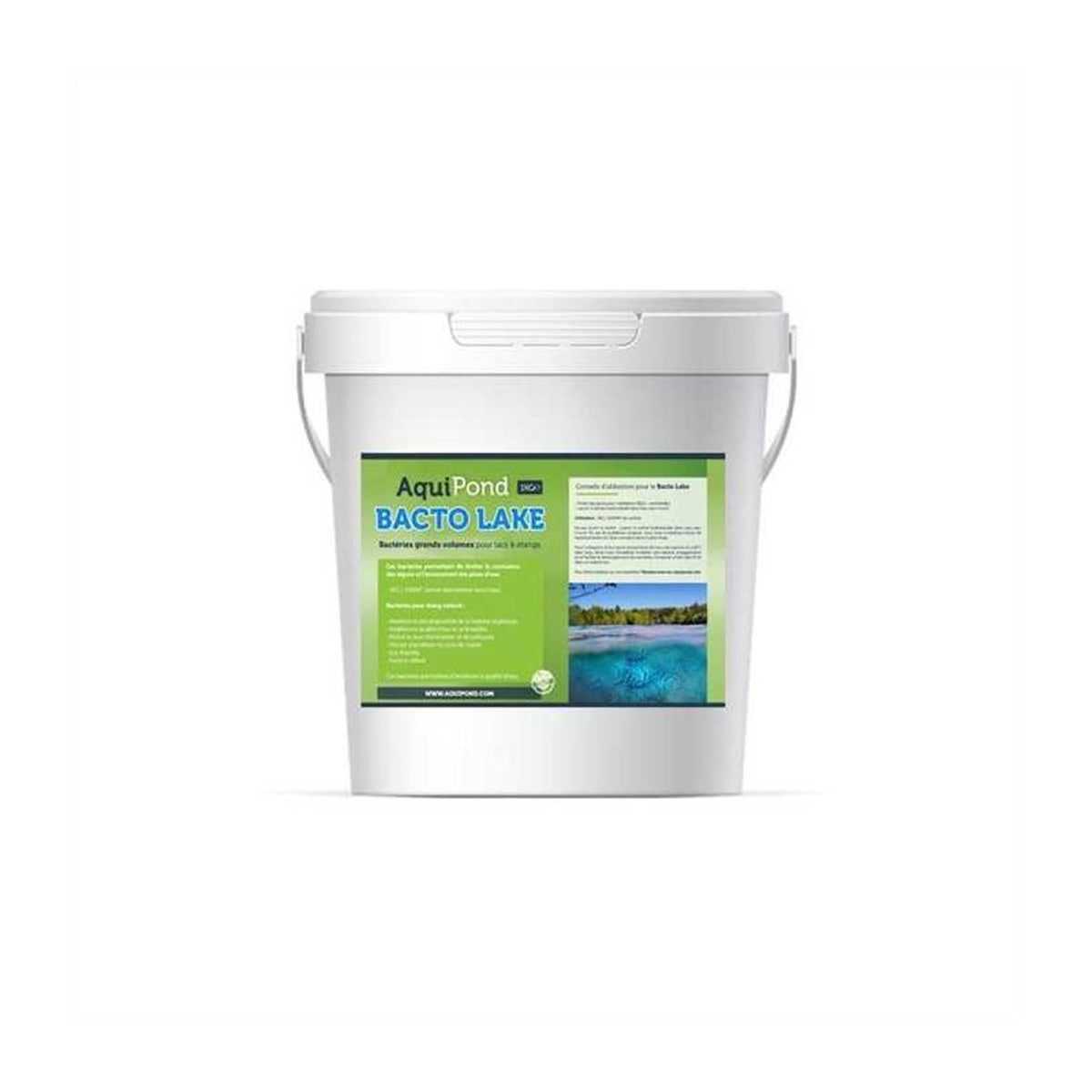
- Strengthen the water's biology. Selected bacteria accelerate the breakdown of dissolved organic matter and compete with algae for nutrients. Bacto Lake, designed for clear water in a natural pond, is dosed at 100 g per 100 m², i.e., 1 kg per 1,000 m². These bacteria work better in oxygenated water and at a spring or summer temperature.
In the long term (the season and those that follow)
- Treat the muck. It is the phosphorus reservoir that restarts the algae every summer. Mechanical dredging is an option for significant siltation (check with the relevant authorities before any dredging). Specialized bacteria such as Bactovase gradually break down organic muck: 100 g/m² for maintenance, 150 to 200 g/m² for a heavily silted pond, in two applications per year, in spring and fall. To go further: how to reduce siltation and organic or mineral muck.
- Fix the phosphorus. A phosphorus binder binds dissolved phosphorus and makes it unavailable to algae. SeDox Max by OASE works in the water and in the muck, at a rate of about 5 kg per 100 m³.
- Install plant competitors. Submerged oxygenating plants, shoreline plants, and floating-leaf plants (water lilies) consume nutrients and shade the water. It is often recommended to cover about one-third of the surface. See our selection of the best oxygenating plants.
- Limit light if necessary. A biological dye filters part of the light that penetrates the water. Blue Lake is dosed at one 100 g bag per 1,000 m² against algae, to be renewed every 4 to 6 weeks (Blue Lake presentation).
- Adjust the fish population. Fewer fish means less waste, less stirred-up muck, and more daphnia to filter the water.
- Anticipate fall. Leaves that fall and decompose at the bottom feed the muck for the following year. A net or regular collection makes a real difference (leaves in the pond in fall).
To compose your planting zones: aquatic plants and water lilies.
In spring, a temporary green water phase is common: phytoplankton starts before plants and zooplankton. If the pond is balanced, it fades on its own in a few weeks. It is the persistence of green water in summer that should alert you.
How to make pond water clear depending on its size?
The levers are the same, but their importance changes with the surface area. These guidelines are indicative and also depend on the depth, exposure, and environment of the body of water.
| Type of body of water | Priority levers | To know |
|---|---|---|
| Ornamental pond (less than 50 m²) with pump and filter | Biological filtration, UV-C sterilizer, plants, reasoned feeding | UV-C is very effective on phytoplankton in a filtered pond, but it does not treat the cause. |
| Natural pond (50 to 1,000 m²) | Plants, bacteria for clear water, phosphorus binder, aeration | Mechanical filtration of the entire volume is generally no longer realistic. |
| Large pond (1,000 to 5,000 m²) | Muck treatment, microbubble aeration, management of watershed inputs | The watershed (area whose waters run off into the pond) often weighs more than everything else. |
| Body of water over 5,000 m² | Complete diagnosis, surface aeration or emulsifier, muck management over several years | Multi-year management plan recommended; large volumes react slowly. |
To choose oxygenation equipment depending on the surface area, see how to choose the right aerator for your natural pond.
Before adding bacteria, check:
- KH is equal to or greater than 7.
- Aeration is running, especially at night.
- The UV-C lamp is turned off during treatment.
- Feeding is reduced and floating debris removed.
- No active oxygen treatment in the last 72 hours.
Errors to avoid
- Draining the pond repeatedly. New water often brings its own nutrients, the muck remains in place, and algae start again as soon as temperature and light allow. Draining also stresses the wildlife and destroys useful zooplankton populations.
- Using chemical algaecides. They kill algae all at once, but dead algae decompose, consume oxygen, and release their nutrients: the water turns green again, sometimes more strongly, with a risk of fish mortality. Some products are harmful to wildlife and their use in natural environments may be regulated.
- Overdosing a treatment in the middle of a heatwave. Any rapid degradation of organic matter consumes oxygen. In high heat, treat gradually and oxygenate.
- Feeding the fish "so they are well". In a reasonably populated natural pond, they find a large part of their food. Excess pellets end up as phosphorus.
- Removing all plants. A "clean" pond without vegetation leaves the way free for phytoplankton.
- Waiting for a result in a few days. Biological solutions act on the cause; they require a few weeks and regularity.
Frequently asked questions
How long does it take for a green pond to become clear again?
Generally, a few weeks for visible improvement if you reduce nutrients, oxygenate, and strengthen the water's biology. A stable balance often takes one to two seasons, especially if the pond is silted.
Is green water dangerous for fish?
Phytoplankton itself is not toxic in most cases, but it causes strong variations in oxygen and pH between day and night. The main risk is the lack of oxygen early in the morning in hot weather. Cyanobacteria, on the other hand, can produce toxins.
Should you drain a pond whose water is green?
No. Draining does not remove the muck or the nutrient inputs, and the water turns green again quickly. It is only useful as part of occasional work, such as dredging, to be organized with the agreement of the relevant authorities.
Why does my pond turn green every spring?
In spring, phytoplankton starts faster than aquatic plants and the zooplankton that regulate it. A temporary green phase is therefore normal. If it lasts all summer, it is a sign of excess nutrients, often stored in the muck.
Is a UV sterilizer enough for a natural pond?
A UV-C sterilizer is effective in a pond equipped with a pump and a filter, because all the water passes in front of the lamp. In a large natural pond, this is generally not realistic: you must act on nutrients, muck, plants, and oxygenation.
Read also
- Phosphorus in the pond: sources, measurement and solutions
- Cyanobacteria in a pond: recognize, protect, treat
- Duckweed in a pond: how to get rid of it
Unsure about your body of water? Green water can hide a problem with sludge, phosphorus or oxygen. Use our free diagnostic tool or send us a photo.