In short: phosphorus is the nutrient that most often limits the growth of algae and plants in freshwater: when it is abundant, the pond turns green, becomes covered with duckweed, and can develop cyanobacteria. It comes from leaves, fish food, runoff, birds, and especially the sludge, which releases it when the bottom lacks oxygen. To reduce it, cut off inputs, fix the phosphorus present, reduce the sludge, aerate the bottom, and export the vegetation.
Why is phosphorus so important in a pond?
Algae and plants need light, carbon, nitrogen, and phosphorus to grow. Their growth is limited by the element that is most lacking relative to their needs: this is the concept of a limiting factor. In freshwater, this role is very often played by phosphorus. Algae contain much less of it than nitrogen, but they cannot do without it, and the natural environment provides very little.
Practical consequence: every input of phosphorus is almost directly converted into biomass. Conversely, reducing available phosphorus is the most effective lever for sustainably limiting algae. This is why water body managers prioritize monitoring this parameter.
Where does phosphorus come from in a body of water?
External inputs
- Dead leaves. As they decompose at the bottom, they release the phosphorus they contain. A pond bordered by trees thus receives a significant input every autumn. See our article on leaves in the pond in autumn.
- Fish food. Pellets are rich in phosphorus. What is not retained by the fish ends up in the water, in the form of excrement or uneaten remains.
- Runoff. After rain, water flowing through fields, fertilized lawns, or farmyards carries fertilizers and soil loaded with phosphorus.
- Birds. Ducks, geese, and cormorants bring droppings rich in phosphorus, especially if they are fed on site.
- Make-up water. Depending on the region, distribution, borehole, or stream water may contain phosphates. A test on the filling water allows you to check this.
Sludge, internal reserve
A large part of the phosphorus received by a pond over the years accumulates in the sludge. As long as the bottom surface remains oxygenated, part of this phosphorus remains bound to iron and does not return to the water. When dissolved oxygen (the amount of oxygen available in the water) is depleted at the bottom, which happens in summer in silted or stratified ponds, this bond breaks and the phosphorus is released back into the water. This is called internal loading. This is why a pond can continue to produce algae even after the removal of external inputs. To understand the nature of your bottom, see our article organic or mineral sludge.
What are the consequences of excess phosphorus?
Excess nutrients lead to eutrophication: an enrichment of the aquatic environment in phosphorus and nitrogen that causes plant proliferation, then a high consumption of oxygen during the decomposition of this biomass. Typical signs:
- Green water due to microscopic algae in suspension, and filamentous algae on the edges;
- Duckweed covering the surface in summer;
- Cyanobacteria, sometimes called blue-green algae: they form scums or blue-green films and some produce toxins dangerous to animals and humans. In case of doubt, avoid any contact and follow the instructions of local health authorities;
- Invasive beds of rooted plants that draw phosphorus from the sludge;
- Lack of oxygen at night and at the end of summer, with a risk of fish mortality.
The phenomenon perpetuates itself: the more biomass there is, the thicker the sludge becomes, the more the bottom lacks oxygen, and the more phosphorus it releases.
How to measure the phosphorus in your pond?
Phosphate tests, colorimetric with drops or with powder reagents, measure dissolved phosphate (orthophosphate) in milligrams per liter. You will find them in our water analysis range.
- Take the sample in the right place: about twenty centimeters below the surface, away from the bank and water inlets.
- Take the sample at the same time of day each time, so you can compare.
- Check the unit: some tests display phosphate (PO₄), others phosphorus (P). To go from PO₄ to P, multiply by about 0.33.
- Record the result with the date, temperature, and appearance of the water.
- Repeat the measurement in spring, summer, and autumn, and also test the make-up water.
For interpretation, stick to orders of magnitude. Clear and balanced water contains very little phosphate: with an amateur test, the value is generally close to the detection limit. A few hundredths of a milligram of phosphorus per liter is already enough to feed a strong production of algae. Watch out for the classic trap: in full bloom of algae, the test can be almost zero, because the algae have already absorbed the dissolved phosphate. The phosphorus is then stored in the biomass and in the sludge.
How to reduce phosphorus in a pond?
1. Cut off inputs at the source
- Create a grassed or planted strip of a few meters between the pond and cultivated or fertilized surfaces;
- Divert loaded runoff (ditches, drains, streams);
- Reduce or eliminate fish feeding and do not feed waterfowl;
- Collect leaves before they fall into the water or place a net in autumn.
2. Fix the phosphorus present
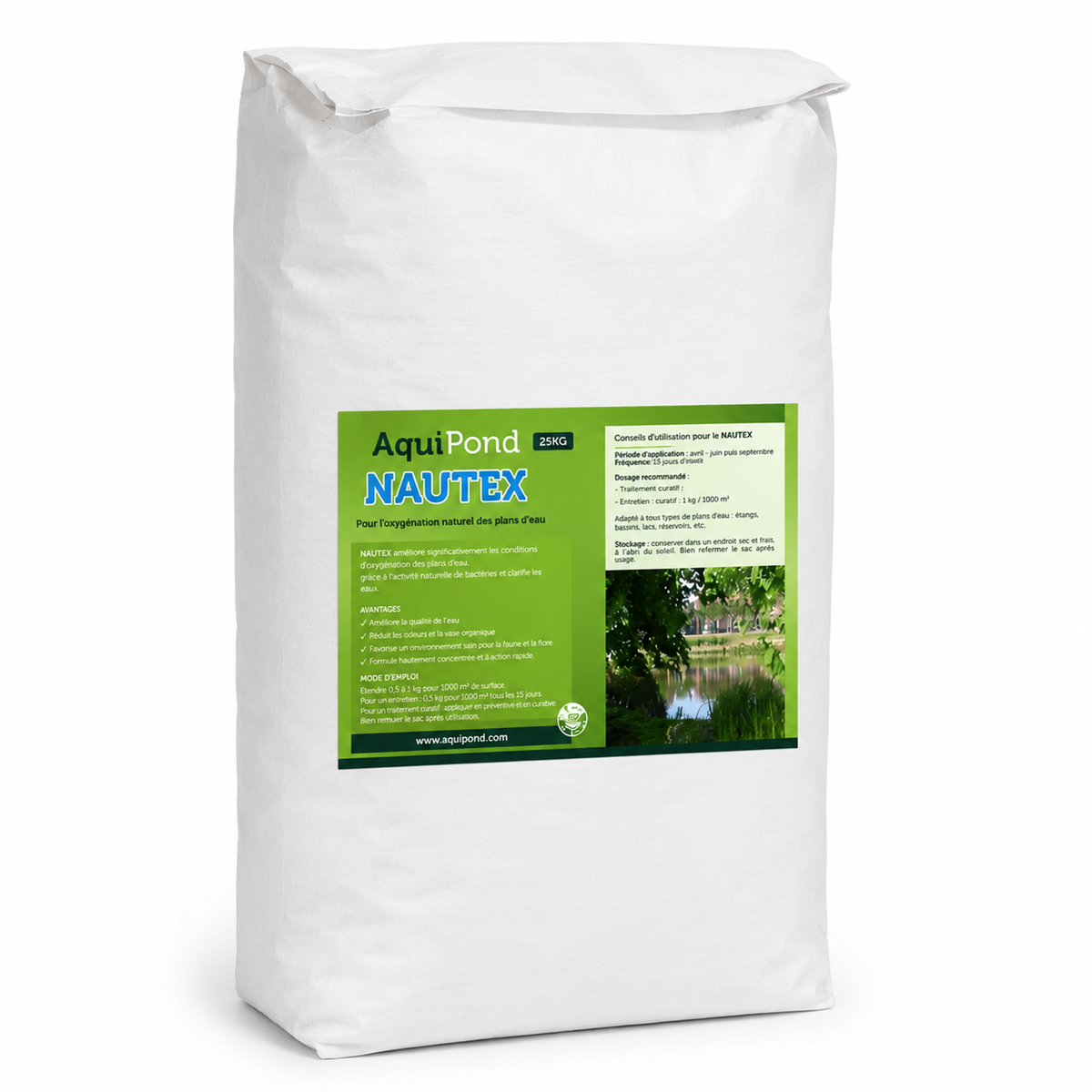
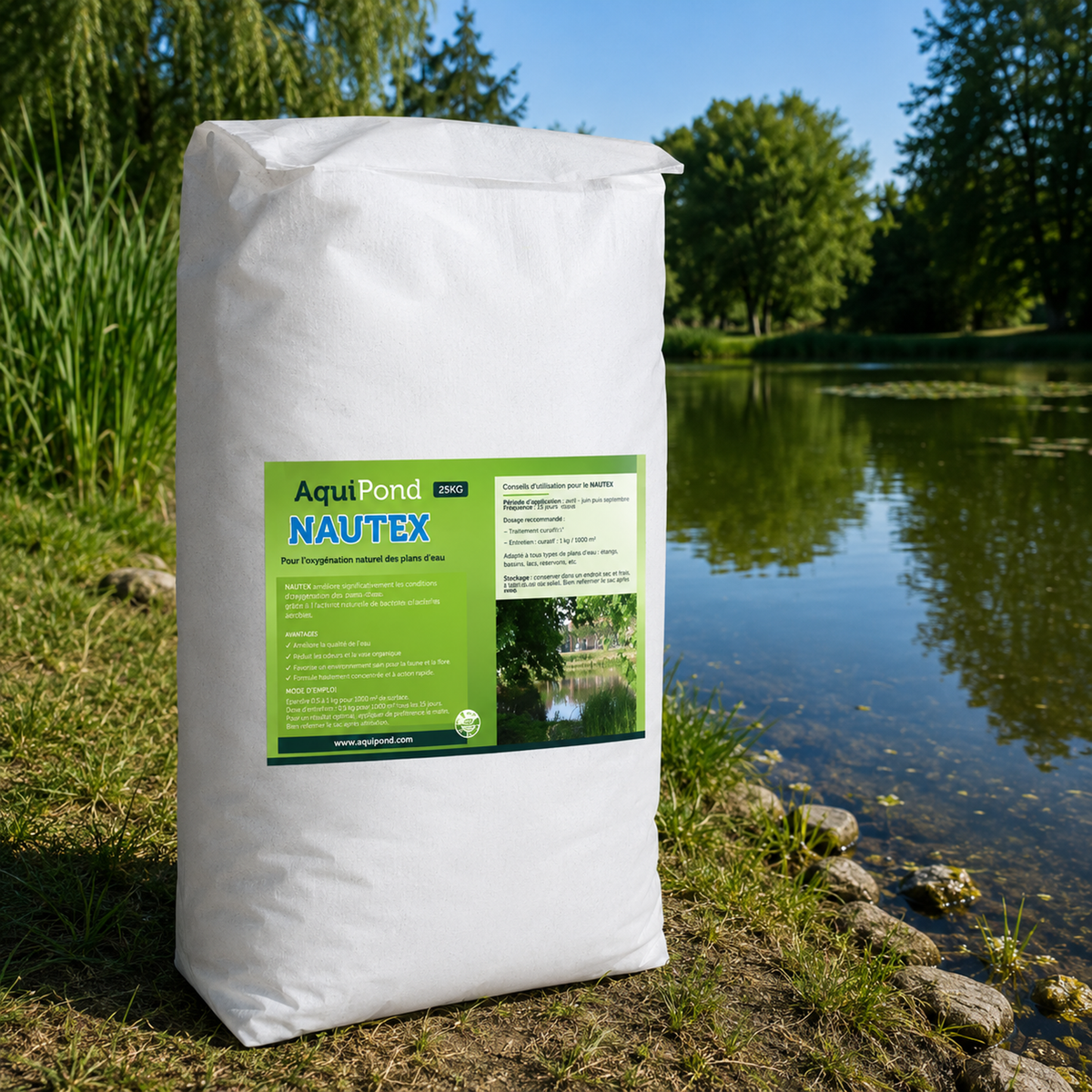
The SeDox Max by OASE is a phosphorus captor that acts in the water and in the sludge, at a rate of about 5 kg per 100 m³. In addition, Nautex natural chalk (calcium carbonate) stabilizes the KH, that is, the water's ability to buffer pH variations, and calcium helps precipitate part of the phosphate at the bottom. Dosage: 80 to 100 g/m² for maintenance, 150 to 200 g/m² for correction. To better understand KH, see our article on the difference between GH and KH.
3. Reduce the sludge
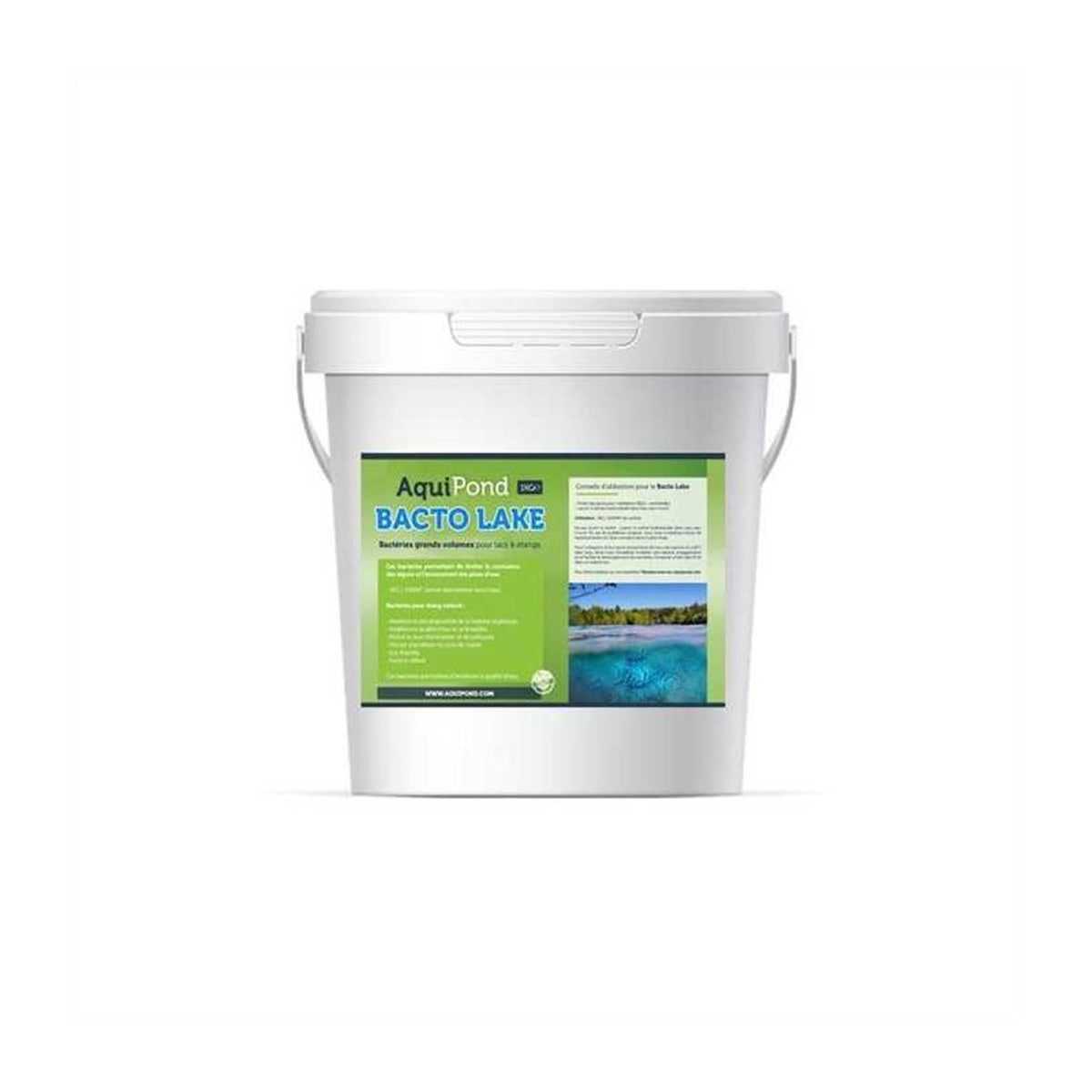
Less organic sludge means less stored phosphorus and less oxygen consumption at the bottom. The bacteria in Bactovase degrade the accumulated organic matter. Count 100 g/m² for maintenance and 150 to 200 g/m² for a heavily silted pond, in two applications per year, in spring and autumn. Our guide reducing siltation details the method.
4. Aerate the bottom
An oxygenated bottom retains its phosphorus better. Aeration by microbubbles diffused near the bottom stirs the water, limits summer stratification, and maintains conditions favorable to the degradation of the sludge. Check our range of aeration for natural ponds and our guide for choosing the right aerator.
5. Let the plants work, then export them
Aquatic plants and bank plants (reeds, irises, rushes, water mint) absorb phosphorus to grow. They only truly remove it if you remove their biomass: cut the bank plants at the end of the season and take the cut plants out of the water. A planted lagoon zone, crossed by water before it reaches the pond, plays the same role of filter.
What action for what source of phosphorus?
| Source | Sign or situation | Recommended action |
|---|---|---|
| Dead leaves | Pond bordered by trees, black and smelly sludge | Net in autumn, collection, Bactovase |
| Fish food | Daily feeding, large population | Reduce rations, adapt the population |
| Runoff and fertilizers | Muddy water after rain, fields or lawns upstream | Grassed strip, diversion of runoff |
| Waterfowl | Permanent presence of ducks or geese | Do not feed them, limit resting areas |
| Make-up water | Phosphates detected in the filling water | Test, change source if possible, fix the phosphorus |
| Sludge (internal loading) | Persistent algae despite stopping inputs, oxygen-free bottom in summer | SeDox Max, bottom aeration, sludge reduction, dredging as a last resort |
Your anti-phosphorus plan for the year:
- Spring: phosphate and KH test, Bactovase, aeration restarted.
- Summer: moderate feeding, oxygen monitoring on warm nights.
- Autumn: net or collection of leaves, Bactovase, cutting and exporting bank plants.
- All year: no fertilizers near the water, no feeding of birds.
Errors to avoid
- Treating algae without treating phosphorus. Algae return as soon as the treatment stops. See our guide for controlling algae.
- Relying on a single test. A low value in summer does not mean that the pond is low in phosphorus.
- Forgetting the sludge. It can release accumulated phosphorus for years.
- Leaving cut plants to rot in the water. Phosphorus immediately returns to the environment.
- Adding fertilizer for aquatic plants in an already rich pond: it directly feeds the algae.
- Brutally stirring the sludge in summer, on an oxygen-deprived bottom: re-suspension releases phosphorus and consumes oxygen.
Frequently asked questions
What phosphate level is normal in a pond?
Clear and balanced water contains very little phosphate: with an amateur test, the value is generally close to the detection limit. Concentrations of around a few hundredths of a milligram of phosphorus per liter are already enough to maintain a strong production of algae. More than the exact value, follow the trend from one measurement to another.
Why is my phosphate test at zero when the water is green?
Because the algae have already absorbed the dissolved phosphate. The test only measures free phosphate in the water, not that stored in the algae, plants, and sludge. A green water with a test at zero remains a pond rich in phosphorus.
How much SeDox Max do I need for my pond?
Count about 5 kg of SeDox Max per 100 m³ of water. To know the volume, multiply the surface area in m² by the average depth in meters. A pond of 200 m² and 1 m average depth contains about 200 m³ and therefore requires about 10 kg.
Do fish bring a lot of phosphorus?
Fish do not create phosphorus: they recycle that from their food. What matters is the food brought from outside. Abundant feeding continuously introduces phosphorus, of which a large part ends up in the water and sludge in the form of excrement and remains.
Is dredging mandatory to eliminate phosphorus?
No, but it is the most radical solution when the sludge is very thick, because it contains the bulk of the phosphorus stock. Before resorting to it, reducing the sludge biologically, fixing the phosphorus, and aerating the bottom often give good results. Dredging is a regulated operation: find out from the water police or the DDT in France, or your regional administration in Belgium.
Also read
- Green water in a pond: causes and sustainable solutions
- Cyanobacteria in a pond: recognize, protect, treat
- Pond dredging: mechanical dredging or bio-dredging, which to choose?
Any doubt about your body of water? You want to know if phosphorus is at the root of your algae and how to reduce it? Use our free diagnostic or send us a photo.